Water Line Repair & Replacement in Jacksonville, FL — Fast Help, Clear Options & 24/7 Emergency Service
Northeast Florida Water Line Services for Homes, Businesses & Commercial Properties
A wet patch that never dries, a sudden drop in water pressure, or an unexplained JEA bill increase deserves more than guesswork. For water line repair in Jacksonville, FL, Cummer Jack Plumbing helps you understand the problem, compare practical solutions, and plan the work without unnecessary surprises.
Serving the Jacksonville community since 2010, our business brings together 60 skilled professionals and six equipped service vans to support residential and commercial plumbing needs. From a damaged meter-to-house connection to a larger service-line replacement, we focus on finding the cause and explaining the proposed scope before work begins.
- Underground water service-line repair and replacement
- Help distinguishing private plumbing problems from utility-side concerns
- Repair options explained before a full replacement is recommended
- 24/7 emergency service for urgent water-supply problems
Call for emergency assistance, appointment availability, and a clear discussion of your water-line concerns.
Request Water Line Service
Fill out the form and we'll contact you immediately!
Water Line Service Backed by 16 Years in the Jacksonville Community
Practical Solutions, Clear Communication & Respect for Your Property
A leaking supply pipe can interrupt your household, close a commercial restroom, or interfere with a business's daily operations. You need a team that considers the entire job—not just the damaged fitting.
Cummer Jack Plumbing approaches water-line work with attention to diagnosis, access, service interruptions, and the condition of the surrounding pipe. We explain whether the proposed work concerns your private service line, indoor distribution piping, or another system so you can make an informed decision.
Water Line Repair Near Jacksonville Neighborhoods & Business Hubs
Serving Westside Properties, Riverside Homes & Commercial Corridors Across the City
From properties near Lane Avenue and Murray Hill to businesses around Baymeadows and St. Johns Town Center, every service-line project has its own access challenges. A paved parking area, landscaped entrance, shared driveway, or busy loading zone can influence how work is planned.
Our Jacksonville location supports service throughout the city and surrounding communities. Tell us where the suspected leak is appearing, whether the property has lost water, and what surfaces or structures lie above the pipe.
Jacksonville Neighborhoods
- Murray Hill
- Riverside
- Arlington Hills
- Mandarin
- Oceanway
- Baymeadows
- Sandalwood
- Cedar Hills
- Jacksonville Heights
Nearby Communities
Property Settings
- Homes
- Retail centers
- Restaurants
- Offices
- Apartment communities
- Warehouses
- Commercial facilities
Explore our service areas or call to discuss coverage for your address.
Specialized Underground Water Line Repair for Residential & Commercial Properties
The Right Repair Starts With Understanding the Entire Connection
A puddle does not reveal the full condition of the pipe beneath it. Before recommending work, the assessment should consider the leak location, pipe material, connection condition, service demands, and whether previous repairs have already affected the line.
For commercial water line repair, planning also needs to account for occupants, customer access, water-dependent equipment, and the timing of any shutdown.
Our service approach emphasizes:
- Identifying the affected pipe and its function
- Evaluating the condition around the immediate failure
- Explaining access requirements before excavation
- Comparing a localized repair with a larger replacement
- Separating plumbing work from concrete, paving, or landscaping restoration
What Happens When a Water Service Line Fails in Jacksonville?
Hidden Leaks Can Waste Water Before They Become Obvious
Your water service line carries water toward the building. A leak along that route can release water underground without creating an indoor puddle. Depending on the location and severity, you may notice persistently wet ground, reduced pressure, or higher recorded consumption.
JEA identifies the property owner as responsible for the line from the meter box to the plumbing inside the structure. Replacement costs on that customer-side portion are the owner's responsibility. If you suspect a leak along this route, professional water leak detection can help identify the source.
Common concerns include:
A symptom is a reason to investigate—not proof that the entire line needs replacement.
Prevent Small Water-Line Concerns From Becoming Larger Problems
A Practical Maintenance Plan Without Unnecessary Certification Claims
Private water service-line maintenance should respond to the property's condition and operating needs. An annual plumbing review can provide a useful opportunity to discuss previous leaks, visible concerns, and changes in water use. It should not be confused with a universal requirement for annual water-line certification.
For businesses, incorporate supply-line concerns into your broader commercial plumbing maintenance plan.
| Task | Description | Typical Timing | Practical Impact |
|---|---|---|---|
| Visible-condition review | Look for accessible leaks, corrosion, and damaged connections | During a scheduled plumbing visit | Identifies conditions needing further investigation |
| Usage review | Compare bills and reported consumption | When usage changes unexpectedly | Helps identify unexplained patterns |
| Shutoff-access review | Identify accessible isolation points | During maintenance planning | Supports a more organized response to a leak |
| Targeted diagnosis | Investigate a specific symptom or suspected failure | When a concern develops | Helps define repair scope |
| Repair documentation | Record the work completed and relevant findings | After service | Supports property records and eligible adjustment requests |
Seasonal Planning
- Review access before landscaping or hardscape projects
- Discuss shutdown-sensitive work before a busy business period
- Investigate persistent wet areas rather than waiting for the next scheduled visit
Frequency depends on the property, previous failures, and actual findings. Additional regulatory obligations may apply to separate systems, such as backflow assemblies; those are not interchangeable with service-line maintenance.
Costs depend on the assessment scope and whether additional diagnostic or repair work is authorized.
- Keep prior repair invoices and available pipe information
- Maintain access to known shutoffs
- Report new leaks or pressure changes promptly
Who Needs Water Line Repair & Replacement in Jacksonville?
From Single-Family Homes to Multi-Building Commercial Properties
Any property with a damaged private supply line may need professional assessment. The right solution depends on the failure—not simply the building category.
Cummer Jack Plumbing serves property owners and managers looking for clear explanations, practical scheduling, and an appropriately defined repair.
For larger sites, identify which buildings or tenants may lose service before authorizing a shutdown.
How Do Local Conditions Affect Your Water-Line Assessment?
Weather, Ground Conditions & Property Layout Can Complicate Diagnosis
In Jacksonville, a wet yard is not automatically evidence of a broken supply line. Rainfall, drainage patterns, irrigation, and plumbing leaks can produce similar-looking symptoms. The assessment needs to distinguish between them rather than assume the cause from the weather or neighborhood.
Likewise, the age of a home does not establish the material or condition of its private service line. JEA provides a service-line inventory map and material-identification guidance to help address that uncertainty.
We base recommendations on the pipe and findings at your property—not broad claims that all coastal or older homes have the same problem. If you need help locating the source, consider our slab leak detection or water leak detection services.
Common Water-Line Materials & Configurations in Jacksonville
Material Identification Helps Inform the Next Step
JEA's verification project considers materials including lead, copper, galvanized steel, and plastic. It also allows owners to look up their address and report private service-line materials. A map entry or visible pipe section is useful information, but it may not describe every concealed connection on the property.
| Material or Configuration | Where It May Be Encountered | Assessment Focus | Important Consideration |
|---|---|---|---|
| Copper | Existing water service and distribution piping | Visible condition, connections, and failure location | Material alone does not establish remaining life |
| Galvanized steel | Older service lines | Corrosion, restriction, and overall condition | JEA advises considering replacement |
| Plastic piping | Existing or replacement service lines | Exact pipe type, condition, and connection compatibility | Suitability depends on the application |
| Lead or unidentified material | Some older or incompletely documented services | Positive identification and utility guidance | Do not assume drinking-water quality from appearance alone |
| Shared or complex service layouts | Commercial and multifamily sites | Routing, ownership, isolation, and demand | Scope may extend beyond one building |
JEA recommends considering replacement when a private service line is lead or galvanized steel. Material identification and water-quality testing address different questions. If your water quality is a concern, learn about our water filtration and water softener services.
Our 6-Step Water Line Repair & Replacement Process
What to Expect From the First Call Through Completion
Initial Call & Property Discussion
Tell us about the symptoms, location, recent utility work, prior repairs, and whether the property still has water.
On-Site Assessment
We review accessible plumbing, the suspected service route, and site conditions. If more diagnostic work is needed, we explain the proposed next step.
Diagnosis & Access Planning
The work plan addresses the likely failure location, access constraints, buried utilities, and potential surface disruption.
Repair or Replacement Options
We explain the recommended scope, alternatives where practical, and why a limited repair or larger replacement may be appropriate.
Authorized Work & Completion Checks
Work proceeds within the agreed scope, with applicable testing, flushing, inspections, and other completion requirements addressed for the project.
Documentation & Follow-Up
You receive the relevant service record, an explanation of completed work, and applicable warranty information. Additional restoration or follow-up responsibilities should be clear.
What Should Your Water-Line Service Include?
Know What You Are Approving Before Work Begins
A useful proposal explains more than "fix leak." It identifies the work area, repair approach, and responsibilities that affect the final result.
The scope for your property should address:
- The reported problem and assessment findings
- Any separately priced diagnostic work
- The pipe section or route included
- Proposed materials and connections
- Access, excavation, and work-area protection
- Permit or inspection responsibilities where applicable
- Expected service interruptions
- Completion checks and cleanup
- Backfill and surface-restoration responsibilities
- Exclusions and the process for approving additional work
A diagnostic visit does not automatically include excavation, pipe replacement, or finished concrete restoration. Ask for those boundaries in writing.
Clear Planning for Jacksonville Water-Line Projects
Practical Communication for Homeowners & Facility Managers
The most useful service features help you understand what happens next. Cummer Jack Plumbing focuses on connecting the diagnosis, proposed work, and property impact in one understandable plan.
For commercial properties, name a site contact who can approve work and communicate with affected occupants.
What Changes After a Water-Line Problem Is Diagnosed & Addressed?
Understand the Outcome Beyond the Pipe Repair
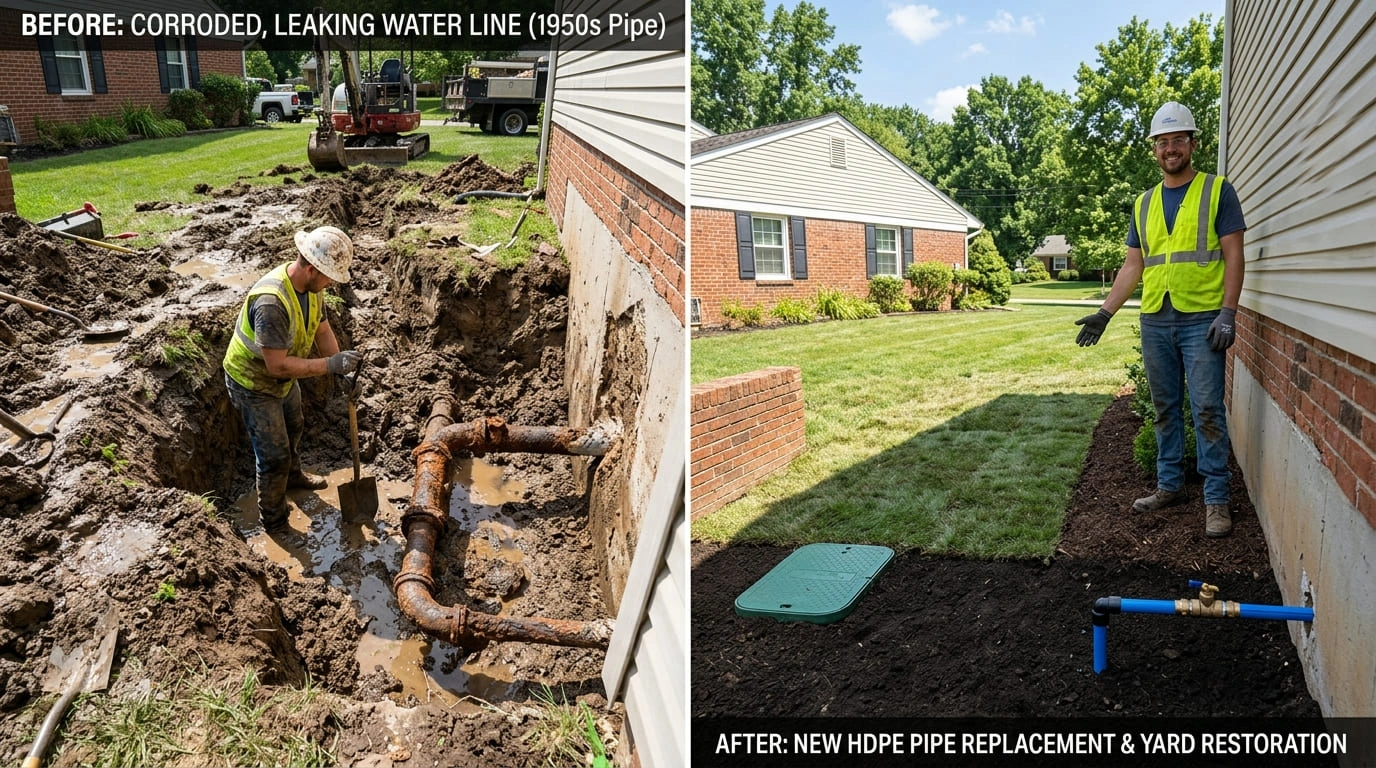
A successful project should leave you with a clearer understanding of the problem, the work completed, and any remaining responsibilities. The result is not simply a new section of pipe—it is a documented response to an identified failure.
Actual outcomes depend on the findings and authorized scope.
How Are Water Lines Repaired or Replaced?
The Method Should Match the Pipe, Site & Applicable Requirements
A localized repair, open-trench replacement, or alternative route may each be appropriate in different circumstances. The best method depends on access, existing utilities, pipe condition, connections, and the work the site can accommodate.
Our planning considers:
- Materials suitable for the intended potable-water application
- Compatibility between new piping and existing connections
- Appropriate sizing for the assessed service demand
- Protection of nearby utilities and structures
- Access for future maintenance
- Applicable testing, flushing, and inspection requirements
- Clear responsibility for final surface restoration
Can the work be completed without removing the whole driveway? Sometimes a more limited access plan may be possible, but no responsible proposal should promise a no-dig solution before evaluating the property. For related underground work, learn about our sewer line repair services.
Should You Repair Your Water Line or Install a New Service?
Compare the Immediate Fix With the Condition of the Remaining Pipe
A single leak does not automatically justify replacing the entire service line. Equally, repairing one weak connection may not be the best investment when the surrounding line has widespread problems.
| Scenario | A Localized Repair May Fit | Replacement May Be More Appropriate |
|---|---|---|
| One isolated failure | Surrounding pipe is serviceable and access is practical | Other findings indicate broader deterioration |
| Repeated leaks | A distinct new cause is identified | Failures suggest a pattern along the line |
| Damaged section beneath paving | Limited access can address the confirmed problem | A new route offers a more suitable long-term approach |
| Uncertain material | Identification can resolve the uncertainty first | Confirmed material and condition support replacement |
| Changed building demand | Existing capacity remains suitable | A properly assessed upgrade is needed |
Consider a larger replacement when:
- Multiple failures have occurred along the same line
- The pipe is extensively compromised
- Repair access would repeatedly disturb the same surfaces
- The proposed replacement addresses a documented material or capacity concern
Ask the contractor to explain what evidence supports the recommendation. For related decisions about indoor piping, explore our pipe repiping services.
What Does Water Line Repair & Replacement Cost in Jacksonville, FL?
A Useful Estimate Explains the Work—Not Just the Total
There is no responsible single price for every underground leak. A short, accessible repair and a long replacement beneath paved areas are different projects.
Your estimate may be influenced by:
- Diagnostic work needed to locate the problem
- Pipe length, route, material, and size
- Excavation depth and access
- Driveway, walkway, or parking-area involvement
- Connections and isolation requirements
- Permit and inspection needs
- Emergency scheduling
- Backfill and restoration scope
| Service Type | How Pricing Is Determined |
|---|---|
| Initial assessment | Visit scope and any additional diagnostic authorization |
| Localized service-line repair | Access, materials, connections, and labor |
| Meter-to-building replacement | Route, length, site constraints, and required work |
| Commercial service-line work | Demand, layout, shutdown planning, and property access |
| Concrete or landscape restoration | Defined separately or included expressly in the proposal |
If two estimates differ substantially, compare leak detection, excavation, pipe scope, restoration, and warranty—not just the bottom line.
Request a Water-Line Cost EstimateWhich Water-Line Problems Should Jacksonville Owners Address?
Act on Confirmed Failures and Persistent Warning Signs
A water-line assessment is appropriate when you have evidence of leakage, unexplained changes in supply, or a material-identification concern. A property does not need a replacement simply because it belongs to a particular building category.
Arrange service when:
If the leak is close to the meter, clarify the affected component and ownership before approving private repairs. JEA's guidance places the owner's service line from the meter box toward the structure under property-owner responsibility. For help locating the issue, our water leak detection service can identify the source before excavation.
Water Line Repair for Commercial & Multi-Unit Properties
Plan the Work Around Occupants, Equipment & Business Operations
A business water-supply interruption can affect restrooms, cleaning, food preparation, tenants, and other daily activities. Commercial plumbing repair requires a clear understanding of which services will be interrupted and who needs advance notice.
Cummer Jack Plumbing works with property owners, managers, and site representatives to define the affected service and organize the next steps.
| Service | Project Focus |
|---|---|
| Commercial leak assessment | Identify the affected line and required diagnostic scope |
| Service-line repair | Address an identified failure within an agreed work area |
| Full service replacement | Plan routing, connections, access, and interruption |
| Multi-building coordination | Clarify isolation points and affected properties |
| Repair documentation | Record completed work for facility files |
Property Types We Serve
Commercial Planning Considerations
| Project Type | Key Considerations |
|---|---|
| Occupied retail or office property | Customer access, tenant notice, and shutdown timing |
| Multifamily community | Resident communication and affected units |
| Large campus | Building-by-building scope and isolation |
| Industrial site | Site-specific safety, access, and operating requirements |
Why Hire a Professional for Water-Line Repair?
Protect the Property Without Guessing at the Cause
Professional service helps turn a symptom into an actionable plan. The value lies in understanding the affected system, choosing an appropriate repair, and identifying work that would otherwise be easy to overlook.
- Reduce unnecessary excavation through better planning
- Distinguish service-line work from indoor plumbing repairs
- Understand when a spot repair is practical
- Identify access and restoration responsibilities
- Plan water interruptions before work begins
- Keep useful records of the completed repair
For business owners, an organized scope also supports coordination between management, maintenance staff, tenants, and other contractors.
What Should You Avoid When You Suspect an Underground Leak?
Do Not Turn a Plumbing Problem Into an Excavation Hazard
Avoid digging into a suspected service route or disturbing utility equipment to find the leak yourself. Underground work can involve facilities that are not visible from the surface.
Sunshine 811 instructs property owners to request utility locating at least two full business days before planned digging. The request day, weekends, and holidays do not count toward that waiting period.
Safety Precautions
- Do not enter unstable, washed-out, or unsupported ground
- Keep people away from visibly undermined paving
- Do not force a seized valve or tamper with utility equipment
- Avoid standing water near electrical equipment
- Tell the service team if you suspect an immediate safety hazard
A utility-locate request is an important part of excavation planning; it is not a substitute for diagnosing the plumbing failure.
Call for Professional Water-Line AssistanceAnswers to Common Water Line Repair & Replacement Questions
Clear Answers About JEA, Driveways, Costs & Repair Options
JEA states that the property owner owns the line from the meter box to the plumbing inside the structure. Customer-side replacement costs are the owner's responsibility. If the leak location is uncertain or involves meter equipment, clarify the affected component with JEA before authorizing work.
An underground leak is one possible explanation, but not the only one. Review your usage, consider other water-consuming fixtures or systems, and arrange professional leak detection rather than assuming the meter or service line is at fault.
A limited access opening or another route may be possible, depending on the site. The assessment should establish where the problem is and explain the proposed access and restoration.
When the location is uncertain, additional diagnosis may be needed to produce a meaningful scope. Ask whether diagnostic work is included or separately priced. Our slab leak detection service can help pinpoint concealed failures.
No. Service-line replacement addresses the supply connection serving the building. A whole-house repipe addresses indoor distribution piping. A slab leak may involve a separate concealed section. These services require clearly defined scopes.
JEA considers eligible adjustment requests but does not guarantee a credit. Its residential form requires a plumber's statement or receipt for completed repairs involving water that did not enter the sewer system. Requests generally must be submitted within 90 days of the billing period in question.
Do not assume it does. Ask about the project boundaries. JEA separately identifies private meter-to-home replacement as a customer responsibility.
Document the condition and timing, contact JEA, and avoid assigning responsibility before the failure location is assessed. A sequence of events alone does not establish who caused the damage.
No. Age is context, not a diagnosis. Material, condition, failure history, and actual findings should inform the recommendation.
Yes. Cummer Jack Plumbing offers 24/7 emergency service. Call (904) 227-4220 with your location and symptoms so the urgency and available response can be discussed.
Clear Expectations From Assessment Through Follow-Up
Understand the Work, the Limitations & the Next Step
You should know what you are authorizing and what happens if a concern develops afterward. Our approach centers on explaining the recommended work, documenting the agreed scope, and discussing applicable follow-up.
If a repaired area appears to be leaking again, contact us promptly with the invoice and a description of the symptoms. The next step depends on the findings, the original work, and the applicable written warranty.
Cummer Jack Plumbing
735 Lane Ave N
Jacksonville, FL 32254, United States
Licensing & Qualifications for Jacksonville Plumbing Projects
Water-Line Work Should Match the Contractor's Authorized Scope
Different credentials serve different purposes. Contractor licensing, individual training, underground utility qualifications, and specialized certifications should not be treated as interchangeable.
For your project, discuss:
- The business responsible for the plumbing work
- The license applicable to the proposed scope
- Who will supervise and perform the work
- Whether separate excavation or utility work is involved
- Who handles permits and required inspections
- Any site-specific commercial qualifications
A medical-gas credential, for example, does not by itself establish the scope of a private water service-line project. The relevant qualification is the one that applies to the work being performed. Learn more about our team and credentials.
Emergency Water Line Repair in Jacksonville
Call When a Leak Threatens Water Service or Property Access
Water surfacing rapidly, a sudden loss of supply, or worsening conditions around paving can require prompt attention. Call Cummer Jack Plumbing to describe what is happening and discuss the available response.
Our emergency-service discussion focuses on:
- Your address and immediate conditions
- Whether anyone is at risk
- Whether water is still flowing into the affected area
- Whether JEA or another utility has already been contacted
- Access conditions and available service arrangements
Urgent Situations May Include
Emergency availability does not eliminate utility-locating, inspection, or site-safety requirements. Immediate mitigation and permanent repair may involve different stages. If water has already caused damage, explore our water damage restoration services.
Call (904) 227-4220Documentation Support After a Water-Line Incident
Keep the Repair Facts Separate From Coverage Decisions
If a water-line failure contributes to property damage, clear records can help explain what was found and repaired. Your insurer determines coverage under the policy; a plumbing invoice does not guarantee payment.
Ask about available documentation such as:
- Photographs of accessible damage
- Assessment notes
- The identified failure location
- Description of authorized work
- Materials and connections replaced
- Itemized invoices
- Relevant completion records
Report the facts accurately. Sudden damage, longstanding deterioration, the failed pipe itself, and resulting damage may be treated differently under a policy. Discuss those questions directly with your insurer or agent.
Water-Line Repair & Replacement Warranty Details
Written Terms Matter More Than a Broad Promise
Warranty coverage should be explained for the specific work. A repair warranty and a manufacturer's product warranty are different protections, and neither should be assumed to cover unrelated plumbing.
| Coverage Area | What to Clarify |
|---|---|
| Workmanship | Covered work, duration, and claim procedure |
| Materials or products | Applicable manufacturer terms |
| Existing pipe | Whether unreplaced sections are excluded |
| Surface restoration | Whether any separate restoration warranty applies |
| Follow-up | How to report a concern and arrange assessment |
Keep your proposal, invoice, and warranty information together. If a new symptom develops, report it promptly rather than assuming it is covered or unrelated.
Six Equipped Service Vans Supporting Jacksonville Plumbing Calls
People, Tools & Planning for Different Job Sizes
Cummer Jack Plumbing's six service vans support a 60-person team serving residential and commercial customers. That capacity helps organize local service needs, but every underground project still requires the right site-specific plan.
Depending on the work, planning may involve:
- Diagnostic equipment appropriate to the suspected problem
- Pipe and fittings matched to the approved repair
- Excavation or access arrangements
- Work-area protection
- Testing and completion equipment
- Additional materials or machinery for larger replacements
A stocked van can support efficiency, but it does not mean every buried-line failure can be permanently resolved in one visit.
Discuss Payment Arrangements for Major Water-Line Projects
Start With a Defined Scope and a Written Price
A service-line replacement can be an unexpected expense. Before comparing payment methods, make sure you understand the proposed work, alternatives, and any separately priced restoration.
When discussing your project:
- Ask which payment methods are accepted
- Request the payment schedule in writing
- Ask whether any financing arrangement is currently available
- Review interest, fees, eligibility, and total repayment if financing is offered
- Avoid assuming that phased billing means interest-free financing
Project approval should be based on a clear scope and understandable terms—not pressure to sign before you have reviewed the estimate.
Evaluate Cummer Jack Plumbing by the Work Behind the Name
Clear Recommendations, Organized Service & Useful Documentation
Recognition can introduce you to a business, but your water-line decision should rest on the proposal in front of you. Look for a clear explanation of the problem, a defined scope, and practical answers about disruption and restoration.
The standards to expect include:
- An understandable assessment
- Recommendations tied to actual findings
- Respectful communication
- Clear authorization before additional work
- Accurate records of the completed service
- A defined follow-up process
For a hidden leak or major replacement, those details are more useful than a decorative award display.
Ask About Senior, Military & Plumbing Repair Offers
Understand Eligibility Before Applying a Promotion
If you are a senior customer, active-duty service member, or veteran, ask whether a qualifying offer is available for your project. Do not assume that a discount applies to every diagnostic visit, emergency call, or replacement.
Cummer Jack Plumbing's advertised offer information includes $50 off a qualifying plumbing repair. Ask how the offer applies to the authorized water-line scope.
Before booking, clarify:
- Whether the proposed work qualifies
- Any minimum purchase or exclusions
- Whether emergency charges are eligible
- Whether offers can be combined
- Whether the discount appears in the written estimate
A promotion should make the final price clearer—not distract from the work included.
Water-Line Service Hours in Jacksonville, FL
24/7 Emergency Availability With Project Scheduling Based on the Work
Call any day to discuss an urgent water-line problem. Scheduled diagnosis, excavation, inspections, and restoration may require separate coordination.
| Day | Emergency Service Availability |
|---|---|
| Monday | 24 hours |
| Tuesday | 24 hours |
| Wednesday | 24 hours |
| Thursday | 24 hours |
| Friday | 24 hours |
| Saturday | 24 hours |
| Sunday | 24 hours |
Phone: (904) 227-4220
Email: cummerjacksonplumbing@gmail.com
Website: emergencyplumberjacksonvillefl.com
Tell us whether you need immediate assistance, a planned assessment, or an estimate for a known repair.
How Should You Compare Jacksonville Water-Line Contractors?
Ask the Same Questions Before Choosing a Provider
A useful comparison focuses on what each proposal includes. A lower total may exclude diagnosis or restoration; a higher total may include work you do not need. Ask each provider to explain the difference.
| Comparison Point | What to Discuss With Cummer Jack Plumbing | What to Ask Any Other Provider |
|---|---|---|
| Diagnosis | What findings support the recommendation? | Is the failure confirmed or assumed? |
| Repair options | Is a localized repair practical? | Why is replacement recommended? |
| Access | What surfaces will be disturbed? | Is access work included? |
| Restoration | Who handles backfill and finished surfaces? | Are concrete and landscaping excluded? |
| Shutdown | Which areas lose water and when? | How is occupant notice coordinated? |
| Documentation | What records are provided? | Is the completed scope recorded clearly? |
| Warranty | What written terms apply? | What is covered and excluded? |
Choose the proposal you understand—not simply the one with the strongest headline.
Contact Cummer Jack Plumbing for Water Line Repair & Replacement in Jacksonville
Tell Us What You Are Seeing—We'll Help You Plan the Next Step
Whether water is appearing beneath a driveway, your JEA usage has increased, or you are comparing repair and replacement recommendations, start with a clear conversation.
Tell us where the symptoms are appearing, how long they have been present, whether the property still has water, and whether anyone has already inspected the line. For commercial properties, include your preferred site contact and any restrictions on shutdowns or access.
Contact Cummer Jack Plumbing
(904) 227-4220
cummerjacksonplumbing@gmail.com
Water Line Repair & Replacement
735 Lane Ave N
Jacksonville, FL 32254, United States
24/7 Emergency Service Available
Current Special Offers
- $29 Water Heater Flush & Maintenance
- $50 Off Any Plumbing Repair
- $99 Drain Clearing Special
- Free In-Home Water Quality Test
- Up to $500 Off Water Heater Replacement
Contact Cummer Jack Plumbing for water line repair in Jacksonville, FL, and take the next step toward a clearly diagnosed problem and a practical repair plan.
Water Line Service Areas Near Jacksonville, FL
Our team of 60 professionals responds fast across Northeast Florida with 6 fully equipped service vans for water line repair and replacement.