Hydro Jetting Services in Jacksonville, FL — Clear Stubborn Clogs, Restore Drainage
Northeast Florida hydro jetting for homes, restaurants, commercial buildings, and managed properties
When a drain keeps clogging after snaking, another temporary opening may not address the buildup left inside the line. Hydro jetting in Jacksonville, FL gives property owners an option for cleaning suitable drain and sewer pipes with controlled, high-pressure water.
Cummer Jack Plumbing helps homeowners, businesses, HOAs, and facility managers address recurring kitchen clogs, grease-coated drains, and obstructed sewer lines. Established in 2010, our business brings a team of 60 skilled professionals, six equipped service vans, and 24/7 availability to Jacksonville plumbing problems.
The right starting point is assessment: understanding the blockage, the pipe's condition, and the access available before choosing a cleaning method.
- Residential and commercial drain-cleaning solutions
- Pipe-condition assessment before aggressive cleaning
- Clear explanations of cleaning, descaling, and repair options
- Around-the-clock contact for urgent drain and sewer problems
Call +1 (904) 227-4220 to discuss your symptoms, appointment availability, and the appropriate next step.
Request Hydro Jetting Service
Fill out the form and we'll contact you immediately!
Drain and Sewer Cleaning Backed by Experience Since 2010
Practical plumbing support without a one-method-fits-all recommendation
A clogged drain deserves more than a recommendation based on symptoms alone. A greasy kitchen branch, a root-obstructed sewer, and a deteriorated cast-iron line can require different approaches.
Cummer Jack Plumbing combines residential service and repair with commercial and industrial plumbing capabilities. That broader perspective matters when a drainage problem involves more than removable buildup. We can discuss cleaning alongside related services such as sewer camera inspection, pipe repair, and trenchless rehabilitation.
Hydro Jetting Near Jacksonville Neighborhoods and Business Hubs
Serving residential streets, retail corridors, restaurants, and managed properties
Drain problems can interrupt a household near Riverside, a restaurant in Baymeadows, or a managed property in Mandarin. Our Jacksonville location provides a local point of contact for arranging service across the city and surrounding service areas.
Whether your property is near the Cummer Museum of Art & Gardens, St. Johns Town Center, or an established neighborhood corridor, explain the access conditions when you call. Parking restrictions, locked service areas, operating hours, and cleanout locations can all affect planning.
Jacksonville Neighborhoods We Serve
Nearby Service Areas
Local Property Settings
- Neighborhood homes
- Shopping centers
- Hospitality properties
- Commercial kitchens
- Apartment communities
- Industrial facilities
Looking for sewer jetting in Northeast Florida? Call with your address and symptoms so we can discuss location-specific scheduling.
Specialized Commercial Hydro Jetting in Jacksonville, FL
Match the equipment and cleaning method to the actual pipe condition
Professional sewer cleaning requires decisions about access, pipe material, obstruction type, nozzle selection, water delivery, and the condition of the downstream line. More pressure is not automatically better.
Old cast iron, brittle clay, displaced joints, and existing pipe damage require particular caution. A local drain-cleaning comparison likewise identifies camera assessment as an important consideration before jetting vulnerable older materials.
Our service discussion focuses on:
- Whether the problem affects one fixture, a branch line, or the main sewer
- Whether inspection is needed before selecting a method
- Whether buildup is removable without worsening existing defects
- Whether cleaning alone can reasonably address the complaint
- What additional repair or rehabilitation may be appropriate
For restaurant drain jetting, property-management work, and residential sewer cleaning, the objective is the same: recommend work that fits the problem.
Why Does Your Drain Keep Clogging After Snaking?
A reopened drain is not always a thoroughly cleaned drain
A drain snake can be an effective tool for many isolated clogs. However, restoring a passage through an obstruction may leave grease or other buildup along the pipe walls. That remaining material can contribute to another blockage.
Recurring backups can also involve roots, damaged joints, a sagging section, or another structural problem. Cleaning does not correct every cause of poor drainage.
Warning Signs Worth Discussing
- A kitchen sink that slows down again shortly after cleaning
- Multiple fixtures draining poorly at the same time
- Wastewater appearing at a lower fixture when another fixture runs
- Repeat main-line blockages
- Gurgling associated with slow drainage
- Sewer odors that persist after ordinary fixture maintenance
Delaying assessment can leave a business facing restroom closures, interrupted kitchen operations, or a larger cleanup problem. If you recognize these symptoms, contact our team to discuss an assessment.
How Often Should Sewer Lines Be Hydro Jetted?
Build a maintenance schedule around the property — not an automatic annual cleaning rule
Hydro jetting is not an annual certification service for every Jacksonville property. Cleaning frequency should reflect inspection findings, previous blockages, business activity, and the condition of the line.
A busy commercial kitchen may need a different maintenance approach from a home with no history of drainage trouble. Scheduling an annual review can be useful for some properties without making annual jetting necessary.
| Maintenance Task | Description | Typical Timing | Practical Impact |
|---|---|---|---|
| Drainage-history review | Discuss slow drains, backups, and prior cleaning | During assessment or a planned review | Identifies recurring patterns |
| Access inspection | Locate usable cleanouts and service points | Before planned cleaning | Helps define safe access |
| Camera inspection | Assess visible pipe conditions where access permits | When needed for diagnosis or follow-up | Helps distinguish buildup from defects |
| Targeted cleaning | Clean the approved line or section | Based on findings and usage | Removes suitable obstructions |
| Service documentation | Record work performed and recommendations | After the visit | Supports maintenance planning |
| Repair evaluation | Review defects cleaning cannot correct | When identified | Reduces repeated spending on unsuitable cleaning |
Seasonal Planning
- Arrange commercial work around operating schedules and peak business periods
- Review known drainage trouble before a busy rental or hospitality season
- Investigate rain-related backups rather than assuming another cleaning is the answer
Frequency depends on the property. A recurring blockage is a reason to reassess the cause, not simply shorten the interval between identical treatments. Costs depend on scope, access, line conditions, and any additional inspection or repair.
Maintenance Tips
- Keep cleanouts accessible
- Retain previous inspection footage and invoices
- Record which fixtures are affected and when symptoms occur
- Report repeat problems promptly
Who Can Benefit from Professional Hydro Jetting?
Residential service and commercial plumbing support across Jacksonville
The service is most useful when the pipe and obstruction are suitable for water-based cleaning. Property type alone does not determine whether jetting is appropriate.
Cummer Jack Plumbing works with:
- Homeowners experiencing recurring kitchen or main-line clogs
- Restaurants, cafes, and food-service facilities
- Office buildings, retail centers, and mixed-use properties
- Schools, churches, and community buildings
- Apartment communities and HOA-managed properties
- Hotels and hospitality facilities
- Warehouses, industrial buildings, and commercial campuses
For managed properties, provide the affected building, unit numbers, shared-line history, and any restrictions on water use or tenant access.
How Do Local Weather and Property Use Affect Sewer Problems?
Separate removable buildup from infiltration, heavy usage, and existing defects
A drainage problem that appears during heavy rain is not automatically a grease clog. It may require investigation of damaged piping, unwanted water entering the system, public-system conditions, or a separate outdoor drainage issue.
Likewise, an older home in Riverside or Murray Hill should not automatically be assumed to have unsafe cast iron. The actual material and condition matter more than the neighborhood name.
- Summer and busy operating periods: higher occupancy or kitchen activity can reveal existing restrictions
- Rainy periods: note whether multiple properties or only your fixtures are affected
- Occasional cold weather: protect exposed plumbing, but do not treat weather protection as a substitute for diagnosing a sewer obstruction
- Year-round commercial use: track grease management, drainage complaints, and cleaning history
For kitchen drains, prevention remains important. JEA specifically warns that hot water and a garbage disposal do not make pouring grease down a drain safe.
Which Pipes and Drain Lines Can Be Considered for Jetting?
Condition, access, and construction determine the appropriate approach
The same cleaning setup is not appropriate for every drain. Pipe dimensions, material, connections, and visible defects influence the recommendation.
| Line or Material | Typical Application | Main Consideration | Potential Approach |
|---|---|---|---|
| PVC drainage pipe | Residential and commercial waste lines | Joint condition, access, and obstruction | Water-based cleaning where suitable |
| Cast-iron drainage | Older buildings and some commercial systems | Corrosion, scale, wall loss, and structural condition | Inspection-led cleaning or descaling evaluation |
| Clay sewer pipe | Some older underground laterals | Cracks, joints, displacement, and roots | Cautious assessment before cleaning |
| Kitchen branch line | Sinks and food-service drainage | Grease loading and usable access | Targeted cleaning and prevention planning |
| Main sewer lateral | Building-to-sewer connection | Length, roots, defects, and downstream conditions | Inspection, cleaning, or repair assessment |
| Shared commercial drain | Multi-tenant and managed properties | Occupancy, connections, and coordination | Planned work with clearly defined limits |
These are assessment categories, not a promise that every line can be safely jetted. Vulnerable or damaged piping may require an alternative. A sewer camera inspection can help determine the appropriate approach.
Our Six-Step Hydro-Jetting Service Process
Know what needs to happen before, during, and after the work
Initial Call and Property Assessment
Describe the affected fixtures, previous blockages, building use, and whether wastewater is actively backing up.
On-Site Inspection and Access Planning
Review accessible service points, working space, pipe information, and any immediate safety concerns.
Diagnostic Work and Suitability Assessment
Determine whether camera inspection, initial blockage clearing, or another diagnostic step is needed. Some fully obstructed lines may need initial access work before useful footage is possible.
Cleaning Recommendation and Scope Approval
Explain the proposed method, the line or section involved, optional work, and known limitations before proceeding.
Cleaning and Outcome Checks
Carry out approved work, check drainage, and use further inspection where appropriate and included.
Documentation and Next-Step Planning
Summarize findings, work performed, remaining concerns, and any recommended maintenance or repair.
If assessment indicates jetting is unsuitable, the conversation should move to the appropriate alternative — not a higher-pressure attempt.
What Is Included in a Hydro-Jetting Quote?
Understand the line being cleaned, the access being used, and the limits of the visit
"Whole-house hydro jetting" can mean different things. It should not be assumed to include every fixture branch, the building sewer, camera footage, mechanical descaling, and access installation.
Your proposed scope should identify:
- The drain or sewer section covered
- The access point to be used
- The recommended cleaning method
- Whether camera inspection is included or separately priced
- Whether mechanical descaling or root cutting is proposed
- Whether access installation or excavation is excluded
- The planned drainage checks
- Available service records and follow-up recommendations
A clear quote makes it easier to compare options and understand what additional work would require separate approval.
Drain-Cleaning Support Built Around Your Building's Needs
Clear communication matters as much as equipment
A homeowner needs an understandable explanation. A restaurant manager may need a work window that protects food preparation. A property manager may need a building-by-building plan.
Cummer Jack Plumbing offers a broader plumbing-service relationship for customers whose drainage problems extend beyond cleaning.
Service Priorities
- Residential and commercial plumbing support
- Discussion of sewer inspection and pipe-repair options
- Coordination around property access and operating schedules
- Clear separation of cleaning work from structural repairs
- Maintenance recommendations based on findings
- 24/7 contact for urgent plumbing concerns
The value is not simply bringing a jetter to the property. It is choosing an appropriate response to the actual drainage problem.
What Should Change After Professional Sewer Cleaning?
Look for documented results — not a promise that every pipe becomes new
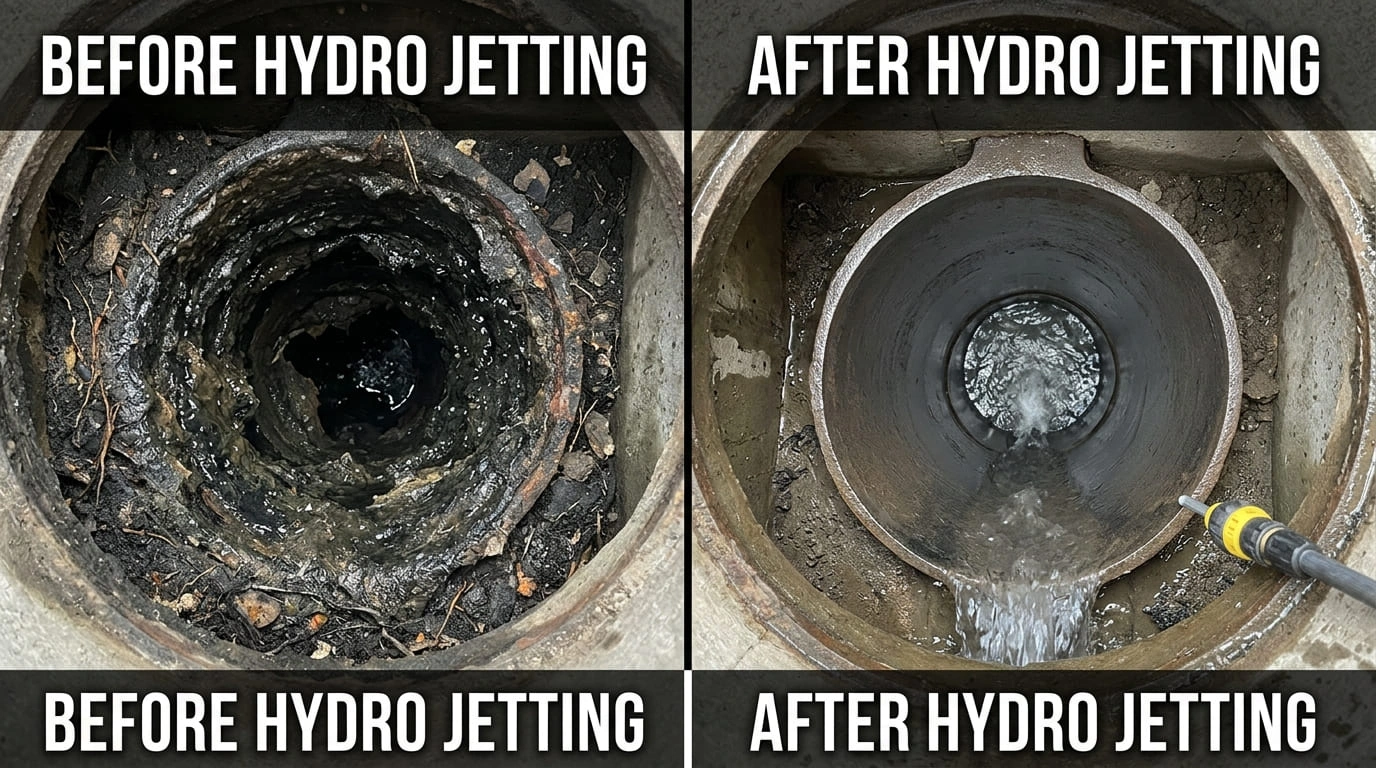
A useful before-and-after comparison shows the same location, explains what was removed, and identifies any remaining defects. Cleaning can improve a suitable line without restoring lost pipe material or correcting its slope.
Repeated clogs with no clear explanation
A documented understanding of the likely obstruction and any visible defects
Buildup obscuring the inspected pipe surface
A clearer view of the cleaned section where inspection is possible
Uncertainty about another cleaning versus repair
A recommendation tied to findings
Scattered maintenance records
A service summary that supports future decisions
The most useful outcome is improved drainage together with an honest explanation of what the work did — and did not — resolve.
How Are Pressure, Nozzles, and Cleaning Methods Selected?
Effective cleaning depends on matching the method to the line
Hydro jetting uses pressurized water delivered through a hose and specialized nozzle to address suitable material inside a drain. The method differs from a cable machine, which mechanically works on an obstruction.
A professional cleaning plan considers:
- Pipe material, diameter, and condition
- Type and extent of buildup
- Available access and downstream flow
- Nozzle characteristics and hose suitability
- Appropriate water delivery and operating settings
- Whether mechanical descaling is needed
- Protection of nearby fixtures and occupied areas
There is no single pressure setting that should be advertised as safe for all pipes. Equipment capability is not the same as the appropriate operating choice for your building.
Can Jetting Fix the Problem — or Does the Sewer Need Repair?
Distinguish removable obstructions from structural defects
Water-based cleaning addresses suitable buildup and blockages. It does not rebuild missing pipe walls, reconnect displaced joints, or correct a belly in the sewer.
| Finding | Cleaning May Help | Repair or Replacement Consideration |
|---|---|---|
| Grease buildup in sound piping | Yes, when access and conditions are suitable | Not usually required for grease alone |
| Roots entering through a defect | May restore a passage or remove suitable root growth | Entry defect may need repair to address recurrence |
| Heavy cast-iron scale | May require combined cleaning and descaling | Structural condition determines whether rehabilitation is reasonable |
| Cracked or collapsed pipe | Cleaning is not a structural remedy | Repair or replacement assessment |
| Sagging section retaining waste | May temporarily remove accumulated material | Slope defect remains |
| Repeated failure after cleaning | Further diagnosis is needed | Evaluate defects and previous treatment limits |
A local drain-cleaning comparison similarly distinguishes clearing roots from correcting the pipe defect through which they enter.
Repair or replacement deserves consideration when the line is structurally compromised, cleaning cannot be performed safely, or repeated cleaning is not addressing the cause. A sewer camera inspection can help clarify the appropriate path forward.
How Much Does Hydro Jetting Cost in Jacksonville, FL?
The useful price is the one tied to your actual scope
There is no responsible single price for every home, restaurant, or commercial sewer. A short accessible branch and a long obstructed main line are different jobs.
Main Cost Drivers
- Number and length of lines
- Diameter and pipe condition
- Blockage type and severity
- Cleanout availability and access restrictions
- Camera inspection or locating requirements
- Mechanical descaling or root-cutting work
- Scheduled versus urgent attendance
- Additional repair work authorized separately
| Service Scope | How the Estimate Is Developed |
|---|---|
| Targeted residential drain cleaning | Based on the affected line, access, and recommended method |
| Main sewer cleaning | Based on length, obstruction, condition, and diagnostic requirements |
| Commercial kitchen line cleaning | Based on grease loading, line layout, and operating constraints |
| Multiple-line commercial work | Based on the agreed building or portfolio scope |
| Descaling plus jetting | Separately identifies the additional mechanical work |
| Access installation or pipe repair | Quoted as additional work when needed |
Our advertised $99 drain-clearing special is not a blanket price for hydro jetting, whole-house cleaning, camera inspection, or sewer repair. Ask which service qualifies and what the offer includes.
Which Drain Problems Justify a Hydro-Jetting Assessment?
The answer depends on the obstruction — not simply the building type
Not every slow drain needs jetting. A straightforward fixture clog may be better addressed with a simpler drain-cleaning method.
An Assessment Is Worth Discussing When:
- The same drain repeatedly blocks after previous cleaning
- Inspection suggests grease or other removable wall buildup
- A main sewer has recurring obstructions
- A commercial kitchen has persistent drainage restrictions
- Suitable root growth obstructs a line
- A pipe needs cleaning before a more complete inspection or rehabilitation evaluation
A pool, medical office, or commercial building does not automatically require routine sewer jetting merely because of its use. Likewise, no universal annual certification requirement should be assumed for this cleaning service.
Sewer Jetting for Restaurants, Commercial Buildings, and Multi-Unit Properties
Plan work around business activity, shared drainage, and property access
Commercial plumbing problems affect more than the fixture where symptoms appear. A restricted shared line can interrupt several tenants, close restrooms, or disrupt a kitchen.
Cummer Jack Plumbing works with businesses and property managers to discuss the affected system, scheduling constraints, and related repair needs.
| Commercial Service | Purpose |
|---|---|
| Drainage assessment | Understand symptoms, layout, and previous incidents |
| Kitchen branch cleaning | Address suitable buildup in agreed lines |
| Main-line cleaning | Address suitable obstructions in a defined sewer section |
| Inspection coordination | Evaluate visible conditions and cleaning results where appropriate |
| Repair planning | Address defects that cleaning cannot correct |
| Maintenance planning | Establish a practical review schedule based on findings |
Property Types We Serve
- Restaurants, cafes, and hospitality venues
- Shopping centers and office parks
- Apartment communities and mixed-use developments
- Schools, churches, and community facilities
- Warehouses and industrial properties
Commercial customers benefit from clearly defined access arrangements, responsibility for shared lines, work windows, and documentation expectations.
Commercial Setting Planning Considerations
| Commercial Setting | Planning Consideration |
|---|---|
| Multi-tenant building | Identify affected tenants and shared connections |
| Restaurant | Coordinate kitchen use and grease-management responsibilities |
| Large campus | Define buildings, zones, and phased access |
| Industrial site | Review site-specific safety and wastewater conditions |
Jetting does not replace grease-interceptor pumping or required grease-management practices. JEA requires connected food-service establishments and commercial/institutional kitchens to participate in its Commercial FOG Program.
Is Hydro Jetting Worth the Money?
Value depends on whether it addresses the actual cause
Jetting may be worthwhile when suitable buildup remains after repeated clearing and the pipe can be cleaned safely. It may offer poor value when the real problem is a collapsed section, a significant belly, or another defect that requires repair.
Professional Assessment Can Help You:
- Avoid paying for the wrong cleaning method
- Understand whether inspection is appropriate
- Compare cleaning with descaling or repair
- Define the scope before authorizing work
- Plan maintenance around actual conditions
- Make more informed decisions about recurring expenses
A simple one-time clog does not automatically justify the most extensive cleaning option.
Can DIY Sewer Jetting Damage Pipes or Cause Injury?
Keep people, fixtures, and existing pipe defects in the safety assessment
High-pressure drain-cleaning equipment is not an ordinary household hose. Improper use can cause serious injury, uncontrolled hose movement, wastewater release, or damage to already vulnerable plumbing.
Safety Priorities
- Restricting access to the work area
- Assessing pipe condition and suitable entry points
- Using equipment appropriate to the line
- Protecting occupied spaces from wastewater exposure
- Avoiding indiscriminate pressure increases when progress stops
During an active sewage backup: stop using connected fixtures where practical and keep children and pets away from contaminated water. Tell the technician about any chemical drain cleaner already used.
Answers to Common Jacksonville Drain-Cleaning Questions
Clear guidance on recurring clogs, pipe safety, roots, and pricing
Neither method is best for every blockage. Snaking can be appropriate for isolated clogs. Water-based cleaning may be considered for suitable wall buildup or recurring obstructions.
Sometimes, but age alone cannot establish suitability. Corrosion, wall loss, cracks, and access conditions matter. Vulnerable older pipe should be assessed with a sewer camera inspection before aggressive cleaning.
Mechanical descaling uses specialized tools to address attached scale. Jetting uses pressurized water to clean suitable material from the line. Some jobs involve both, but they should not be assumed to be interchangeable or automatically included together.
Suitable root growth may be cleared using appropriate equipment. However, cleaning does not repair the opening through which roots entered, so recurrence remains possible. Sewer line repair may be needed to address the entry point.
Possible explanations include residual buildup, renewed root growth, a restriction outside the cleaned section, or an underlying pipe defect. A repeat blockage calls for further diagnosis with a sewer camera inspection rather than an automatic repeat of the same service.
Not necessarily. The written scope should identify whether initial inspection, post-cleaning footage, locating, and recording are included or separately priced.
No. Symptoms and findings should guide the scope. One affected branch does not automatically justify cleaning every line.
It may be considered for a suitable connecting drain, but tank condition, downstream capacity, and the wider septic system need separate consideration. Jetting is not a substitute for septic pumping or drainfield assessment.
The cause may involve infiltration, damaged piping, utility-system conditions, or a different drainage problem. Do not assume a blockage inside the building is responsible. For severe sewage backup, JEA directs customers to call 904-665-6000.
For severe sewage backup or significant water back-flow into a home, JEA directs customers to 904-665-6000, available 24/7. A private plumbing assessment may also be needed depending on the source.
No. JEA warns that running hot water and a garbage disposal while pouring grease down the drain does not prevent clogging.
Cummer Jack Plumbing operates 24/7. Call +1 (904) 227-4220 to discuss the urgency, location, and current service availability.
Understand the Work Before You Authorize It
Scope, limitations, and next steps should be straightforward
A meaningful service commitment begins with explaining the proposed work and its limits. Cleaning cannot guarantee that a damaged pipe will remain trouble-free or that roots will never return.
Before proceeding, discuss the agreed scope, any service-specific guarantee, and the process for reporting a continuing problem. If symptoms return, refer to the invoice and written terms rather than assuming a new blockage is automatically covered.
Plumbing Qualifications for Drain Cleaning and Sewer Repair
The authorization needed depends on the work being performed
Drain cleaning, underground pipe replacement, excavation, and other plumbing activities can involve different responsibilities. A company's wider service list should not be treated as proof that every technician holds every credential.
Relevant Credential Information to Discuss When Booking
- Plumbing-contractor authorization for the proposed scope
- Underground utility and excavation qualifications where applicable
- Technician training for specialized cleaning equipment
- Any permits or inspections associated with additional repair work
- Insurance information relevant to the project
Ask for the applicable business and project details when comparing proposals, particularly when cleaning leads to excavation or pipe replacement.
Emergency Sewer Cleaning in Jacksonville
Call when wastewater backup threatens your home or business operations
A main-line backup can make bathrooms unusable and interrupt everyday activity. Our emergency contact is available around the clock so you can describe the situation and discuss the next step.
Emergency Response Begins With:
- A phone discussion of the affected fixtures and immediate risks
- Review of the property location and access conditions
- Assessment of the likely source and appropriate diagnostic work
- Cleaning, mitigation, or repair planning based on findings
- Documentation of the work performed and remaining concerns
Urgent Scenarios Include:
- Wastewater backing up into lower fixtures
- Multiple drains becoming unusable
- Sewage affecting occupied commercial space
- A shared-line blockage disrupting several units
- Repeat overflow after a previous clearing attempt
Not every emergency requires jetting. The correct response depends on the source and pipe condition.
For severe sewage backup or significant water back-flow into a home, contact JEA at 904-665-6000 as well.
Documentation for Sewer-Backup Insurance Enquiries
Keep the repair record separate from the insurer's coverage decision
If a drainage incident causes property damage, service records can help explain what was observed and what work was performed. Plumbing documentation is not a guarantee that the loss is insured.
Discuss Available Documentation Such As:
- Inspection notes and relevant photographs
- Description of the affected line
- Cleaning or repair invoices
- Camera findings where inspection was performed
- Recommendations for additional investigation or repair
A suspected cause should not be presented as certain unless the evidence supports it. Coverage, deductibles, exclusions, and claim decisions belong with your insurer and policy. If your property suffered water damage, our team can assist with documentation of the plumbing work performed.
Warranty Terms for Cleaning, Repairs, and Installed Parts
A cleared blockage and a repaired pipe are different services
Ask what written terms apply to the specific work before authorizing it. Drain cleaning, pipe repair, and installation of a manufactured component may have different coverage.
| Coverage Category | What to Clarify |
|---|---|
| Cleaning-service terms | Whether any return visit is covered and under what conditions |
| Repair workmanship | Covered labor, duration, exclusions, and reporting procedure |
| Installed parts | Applicable manufacturer terms |
| Existing pipe defects | Whether defects limit or exclude coverage |
| Recurring roots or misuse | How new obstructions and continued grease disposal are treated |
| Service documentation | Which records should be retained |
Keep the invoice and written terms. No universal warranty period should be assumed for every drain or sewer service.
Six Equipped Service Vans Supporting Jacksonville Plumbing Customers
People, equipment, and planning for residential and commercial work
Cummer Jack Plumbing's six service vans support a team of 60 skilled professionals across its plumbing operations. The equipment assigned to a visit depends on the work being scheduled.
When Booking Drain or Sewer Service, Describe:
- Whether the blockage is active
- Which fixtures or units are affected
- Any previous camera findings
- Known cleanout locations
- Parking and access restrictions
- Whether mechanical descaling or specialist equipment has been recommended
Appropriate preparation is more useful than assuming every vehicle carries every tool or replacement part.
Payment Planning for Larger Sewer-Cleaning and Repair Projects
Separate the immediate blockage from any broader capital work
A cleaning visit may identify a separate repair need. For larger projects, request an itemized proposal that distinguishes urgent work from longer-term recommendations.
Ask About:
- Accepted payment methods
- Deposits and payment milestones for larger work
- Whether phased work is technically reasonable
- Any financing arrangements available for your project
- Written terms before accepting a payment plan
Do not assume financing is included or approved. Availability and conditions should be discussed directly before committing to the project.
What Matters When Comparing Jacksonville Plumbing Companies?
Relevant experience and clear proposals should support your decision
Recognition can be useful background, but it does not establish whether a particular drain-cleaning method is suitable for your property.
When Comparing a Plumbing Company, Consider:
- Experience with the line and property type involved
- A clear explanation of inspection and cleaning options
- Written scope and pricing
- Relevant credentials for any additional repair
- Realistic statements about limitations
- Straightforward service and warranty terms
Cummer Jack Plumbing's service discussion should help you understand the proposed work — not require you to rely on an award label to make the decision.
Plumbing Offers for Jacksonville Customers
Discuss eligibility before work is authorized
Senior, military, and veteran customers are welcome to ask about any available customer-specific savings. Do not assume a discount applies automatically to every service.
Current Advertised Offers
- $50 off any plumbing repair
- A $99 drain-clearing special
- A $29 water-heater flush and maintenance offer
- A free in-home water-quality test
- Up to $500 off water-heater replacement
These are different promotions. A water-heater offer does not reduce a sewer-cleaning price, and the drain-clearing special should not be assumed to include hydro jetting. Ask about eligibility, service scope, exclusions, and whether offers can be combined.
Jacksonville Drain-Service Hours
Contact Cummer Jack Plumbing 24 hours a day, seven days a week
Drain and sewer problems do not always occur during ordinary business hours. Our operating schedule provides a 24/7 contact point for routine enquiries and urgent plumbing needs.
| Day | Hours |
|---|---|
| Monday | Open 24 hours |
| Tuesday | Open 24 hours |
| Wednesday | Open 24 hours |
| Thursday | Open 24 hours |
| Friday | Open 24 hours |
| Saturday | Open 24 hours |
| Sunday | Open 24 hours |
Appointment timing depends on location, urgency, access, and service requirements.
Phone: +1 (904) 227-4220
Email: cummerjacksonplumbing@gmail.com
Website: emergencyplumberjacksonvillefl.com
How Should You Compare Hydro-Jetting Providers in Jacksonville?
Use the same questions when reviewing each quote
The lowest initial figure may describe a different scope. Compare the line being cleaned, inspection allowances, access requirements, and any additional work.
| Comparison Point | Discuss with Cummer Jack Plumbing | Ask Any Other Provider |
|---|---|---|
| Proposed method | Why this approach fits the findings | Why jetting rather than snaking or repair? |
| Scope | Exact line or section included | Are all quoted services clearly defined? |
| Inspection | Whether camera work is included | Is footage or locating separately priced? |
| Pipe condition | Known limitations and concerns | What happens if damage is found? |
| Price | Included work and additional charges | Is access work or descaling extra? |
| Availability | Scheduling and urgent-service options | Does availability mean a guaranteed arrival? |
| Follow-up | Written service terms | What happens if symptoms return? |
A larger team, a familiar brand, or a lower advertised price does not replace a suitable method and a clear scope.
Contact Cummer Jack Plumbing for Hydro Jetting in Jacksonville
Discuss your symptoms, your property, and the right next step
Get in Touch
If your kitchen drain repeatedly clogs, your main sewer backs up, or your commercial building has recurring drainage restrictions, start with a conversation about the problem.
Tell us which fixtures are affected, how long it has been happening, what cleaning has already been attempted, and whether you have previous inspection footage. That information helps make the enquiry more useful from the first call.
(904) 227-4220
Hydro Jetting
735 Lane Ave N
Jacksonville, FL 32254, USA
Open 24/7
For hydro jetting in Jacksonville, FL, contact Cummer Jack Plumbing to discuss an assessment and a cleaning or repair plan suited to your property.
Hydro Jetting Service Areas Near Jacksonville, FL
Our team of 60 professionals responds across Northeast Florida with 6 fully equipped service vans for hydro jetting and drain cleaning services.