Water Filter Repair and Replacement in Jacksonville, FL
Northeast Florida water filtration services for dependable flow, better system performance, and fewer unexpected interruptions.
Sulfur smell coming back? Filter housing leaking? RO faucet slowing to a trickle? Cummer Jack Plumbing provides water filtration repair and replacement in Jacksonville, FL, helping homeowners and businesses understand what is wrong before deciding what to replace.
Serving the community since 2010, our team of 60 professionals and six equipped service vans supports residential plumbing, commercial plumbing, and water-treatment needs. From an under-sink filter that stops dispensing to a whole-building system affecting daily operations, we focus on diagnosis, practical options, and clear communication.
- Whole-house filter, under-sink filtration, and reverse osmosis troubleshooting.
- Repair and replacement options explained before authorized work begins.
- Residential and commercial water-treatment support.
- Urgent assistance for leaking equipment and unexpected plumbing failures.
Call Now for Water Filtration Service
Call +1 (904) 227-4220 to discuss the problem and arrange service. Emergency plumbing assistance is available 24/7.
Water Filtration Repair in Jacksonville Backed by Local Plumbing Experience
One team for the filter problem—and the plumbing connected to it.
A filtration problem does not always begin inside the filter. Restricted supply, a faulty valve, a damaged connection, or an issue elsewhere in the plumbing can create similar symptoms. Choosing a company that also handles water lines, leaks, water heaters, and commercial plumbing helps keep the diagnosis focused on the complete system.
Cummer Jack Plumbing brings local service experience, a substantial team, and around-the-clock emergency availability to properties throughout Jacksonville and surrounding communities.
Water Filtration Service for Jacksonville Neighborhoods and Business Properties
Supporting Northeast Florida properties with local service and practical scheduling.
From homes around Murray Hill and Riverside to businesses in Baymeadows and properties in Mandarin, filtration equipment serves different demands. A kitchen drinking-water system needs a different assessment from a filter supplying multiple fixtures or commercial equipment.
Our Jacksonville location on Lane Avenue North provides a local point of contact for property owners seeking existing-system repair, replacement planning, and related plumbing assistance.
Jacksonville Neighborhoods We Serve
Arlington Hills, Baymeadows, Cedar Hills, Jacksonville Heights, Mandarin, Murray Hill, Oceanway, Riverside, Sandalwood, and Windy Hill.
Nearby Communities
Orange Park, Atlantic Beach, Neptune Beach, Jacksonville Beach, Middleburg, and Ponte Vedra Beach.
Familiar Destinations & Business Hubs
The Cummer Museum area, St. Johns Town Center, downtown Jacksonville, and The Avenues area.
Whole-House and Reverse Osmosis Repair Require System-Specific Attention
We look beyond the cartridge to understand the cause.
Two filters can look similar while using different cartridges, operating pressures, connections, and maintenance procedures. Replacing a part without identifying the system can leave the original problem unresolved—or introduce a new leak.
Our approach starts with the equipment model, water source, service history, and symptoms. We then explain the appropriate scope, including whether the work involves filtration components, connected plumbing, or another system.
- Equipment identification before replacement-part selection.
- Assessment of accessible valves, housings, tubing, and connections.
- Evaluation of whole-house versus single-faucet symptoms.
- Repair recommendations matched to the diagnosed fault.
- Commercial plumbing coordination when filtration serves business operations.
Why Has Your Water Filtration System Stopped Working Properly?
Leaks, weak flow, and returning odor deserve different diagnostic paths.
An RO faucet that starts strong and quickly slows down may involve the storage tank rather than the cartridge alone. No flow can involve the supply, blocked filters, or a triggered leak-stop device. Continuous draining can involve the shutoff system and related components. These symptoms require diagnosis rather than automatic full-system replacement.
Common reasons to request service include:
- Water pooling around a housing or under the sink.
- Filtered-water flow that has become unusually weak.
- A filter housing that will not open for maintenance.
- Taste or odor returning sooner than expected.
- RO equipment that continues draining after normal production should stop.
- Repeated cartridge changes that do not resolve the complaint.
Important: A performance problem does not, by itself, prove the water is unsafe. When contamination is suspected, appropriate water testing and public-health guidance matter more than appearance or taste alone.
Prevent Avoidable Problems with Water Filtration Maintenance
Use your equipment's instructions—not a universal replacement calendar.
An annual review can provide a useful maintenance checkpoint, but cartridges, membranes, and treatment media do not all follow the same schedule. Service timing should reflect the manufacturer's instructions, water use, equipment capacity, and operating conditions.
For homeowners and facility managers, maintenance should produce a clear record of what was inspected, changed, and recommended—not a generic certificate implying the water has passed every possible safety test.
| Maintenance Task | What It Involves | Typical Timing | Practical Value |
|---|---|---|---|
| Visual inspection | Check accessible housings, tubing, valves, and connections | At service visits and routine owner checks | Helps identify leaks and damage |
| Cartridge replacement | Install the correct replacement element | Manufacturer interval or capacity limit | Maintains intended filtration performance |
| Operating checks | Review flow, pressure, or RO operation as applicable | During diagnostics or scheduled service | Helps identify restrictions and faults |
| Cleaning or sanitation | Follow equipment-specific procedures | When required by the manufacturer or condition | Supports proper system maintenance |
| Service documentation | Record parts, findings, and next actions | After the visit | Helps track maintenance and warranty requirements |
Seasonal Planning
- Schedule service before periods of increased household or business demand.
- Arrange maintenance before extended closures or reopening where equipment instructions require it.
- Coordinate commercial work around operating hours and production needs.
Frequency and cost depend on the equipment—not a blanket annual certification requirement. Keep equipment accessible, retain model information and service records, and address recurring leaks promptly.
Who Needs Water Filtration Repair in Jacksonville?
Service for everyday household use and business-critical equipment.
A failing filter can interrupt meal preparation at home, reduce drinking-water availability in an office, or affect equipment supplied through a commercial treatment system. The correct service depends on what the filter supplies and how the property uses water.
We assist customers seeking filtration-related plumbing support for:
For tenants, obtain any required owner or property-manager permission before authorizing alterations to installed plumbing.
How Do Local Water Conditions Affect Your Filtration System?
Separate hardness concerns from taste, odor, sediment, and equipment faults.
JEA identifies calcium and magnesium in the Floridan aquifer as the principal hardness minerals. Its published table shows differences across the service territory, including a listed average of 247 ppm for ZIP code 32254. These are area-level values—not a measurement of every individual property.
That distinction matters when a homeowner asks, "Why do I still have white spots after changing my filter?" A sediment or carbon filter is not the same treatment process as a water softener.
- Higher-use periods: Track water use against the filter's rated capacity.
- Extended vacancy: Follow the manufacturer's return-to-service instructions.
- Outdoor installations: Check the equipment's approved exposure conditions and protection requirements.
- Changing symptoms: Compare treated and untreated outlets before assuming the filter has failed.
Northeast Florida water treatment should begin with the actual water source and installed equipment—not a citywide assumption that every property needs the same system.
Which Water Filtration System Is Installed at Your Property?
Whole-house filters, under-sink units, and RO systems perform different jobs.
Identifying the equipment is the first step toward choosing suitable replacement parts and evaluating the complaint. Bring a model number or clear equipment photo when requesting service.
| System Type | Common Application | Main Service Focus | Important Limitation |
|---|---|---|---|
| Sediment cartridge filter | Capturing specified particles | Cartridge condition, housing, seals, and flow | Does not provide universal dissolved-contaminant removal |
| Activated-carbon filter | Specified taste, odor, or chemical-reduction applications | Cartridge or media condition and equipment suitability | Performance depends on the product's specific claims |
| Under-sink drinking-water filter | A dedicated drinking-water outlet | Cartridge compatibility, connections, and faucet flow | Treats the connected outlet, not the entire building |
| Reverse osmosis system | Membrane-based drinking-water treatment | Prefilters, membrane, tank, valves, and drainage | Requires model-specific maintenance |
| Backwashing treatment system | Whole-property treatment for identified conditions | Controls, valves, media, and operating cycle | Media must match the treatment objective |
| Water softener | Hardness reduction | Separate softener diagnosis and maintenance | Is not interchangeable with a general-purpose filter |
JEA describes softening as an option for hardness-related concerns and distinguishes hardness from a health risk. For hardness issues, explore our Water Softener Repair & Replacement service.
Our 6-Step Water Filtration Repair and Replacement Process
Know what happens from the first call to the final handover.
Initial Call & Property Assessment
Tell us whether you use JEA water or a private well, what equipment is installed, and whether the issue involves a leak, odor, taste, flow, or maintenance.
On-Site Inspection & Access Setup
We review the accessible installation, identify components, and establish the appropriate service conditions.
Diagnostic Work
Checks are selected for the system and complaint. These may include supply, flow, connections, operating behavior, and relevant equipment measurements.
Repair or Replacement Recommendations
We explain the findings and proposed work, including whether the fault can be addressed without replacing the complete system.
Approved Work & Service Records
Authorized repairs or replacement are followed by appropriate operating checks and a record of the work performed.
Follow-Up & Maintenance Guidance
You receive relevant care instructions, replacement-part information, and guidance on the next maintenance step.
What Is Included in a Water Filtration Service Visit?
Understand the difference between diagnosis, maintenance, and replacement.
A diagnostic visit identifies the problem and establishes the next step. Replacement cartridges, specialty parts, laboratory testing, and new equipment may involve a separate scope. Your estimate should make those distinctions clear.
Depending on the authorized work, service may include:
- Equipment and installation identification.
- Visual inspection of accessible components.
- Checks relevant to the reported symptom.
- Explanation of findings and recommended options.
- Replacement of approved parts or equipment.
- Manufacturer-directed flushing or startup procedures.
- Leak and operating checks appropriate to the work.
- A service summary and maintenance recommendations.
Ask about any exclusions before approving work, particularly for concealed plumbing, inaccessible equipment, or specialty treatment components.
Water Treatment Service Connected to Complete Plumbing Care
Clear recommendations, coordinated work, and attention to the surrounding system.
Filtration equipment connects to a larger plumbing system. When a filter complaint involves a supply valve, leak, water heater, or commercial distribution issue, the surrounding plumbing matters.
Cummer Jack Plumbing combines water-treatment services with broader residential and commercial plumbing support.
- One point of contact for filtration and related plumbing concerns.
- Repair-versus-replacement discussions based on the problem.
- Service planning for occupied homes and operating businesses.
- Emergency availability for urgent plumbing failures.
- Maintenance guidance that identifies the equipment and replacement components.
What Should Improve After Water Filtration Service?
Useful outcomes are specific, observable, and tied to the original complaint.
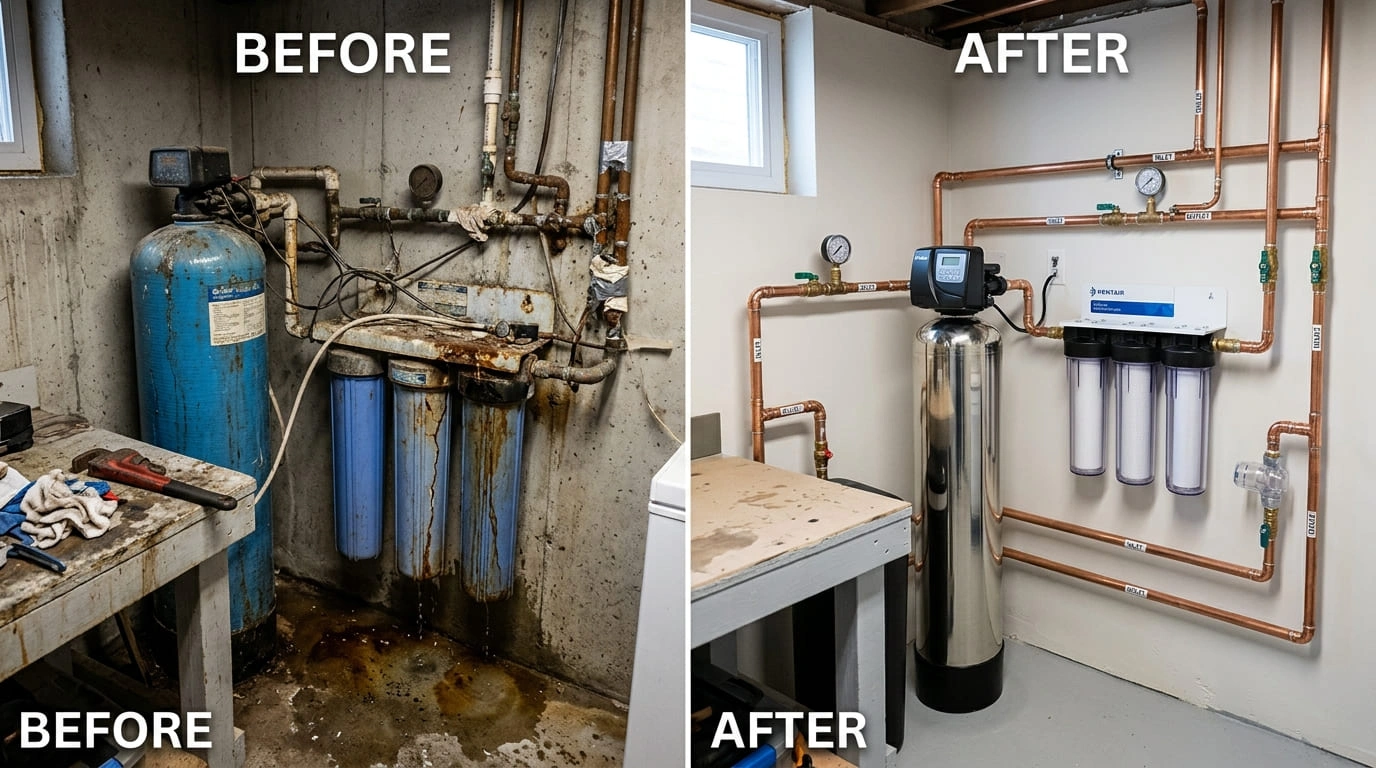
Successful service should address the diagnosed fault. That may mean stopping a fitting leak, correcting a flow problem, replacing an exhausted cartridge, or identifying that the odor originates somewhere other than the filter.
Water collecting beneath an under-sink unit.
The identified leak is repaired and the serviced connections are checked.
An RO faucet slows after a small amount of use.
Tank and system operation are evaluated, with the relevant fault addressed.
Nobody knows which cartridge belongs in the housing.
Equipment details and the correct replacement specification are recorded.
Repeated filter purchases without a clear result.
A diagnosis explains whether filtration, softening, or another plumbing service is appropriate.
These are examples of service objectives, not representations of individual customer projects.
How We Approach Filter Housing, Cartridge, and RO Component Replacement
A part that fits physically is not automatically the correct replacement.
Replacement selection should consider the equipment model, dimensions, connections, operating ratings, and intended treatment function. An unsuitable cartridge can create disappointing performance even when the housing closes correctly.
Our service approach emphasizes:
- Replacement components matched to the equipment.
- Suitable seals, tubing, valves, and fittings for the application.
- Inspection of damaged or deteriorated housings.
- Manufacturer-directed installation and startup procedures.
- Access for future cartridge changes and maintenance.
- Appropriate post-service leak and operation checks.
RO troubleshooting can involve the tank, shutoff assembly, check valve, drain arrangement, or supply—not just the membrane.
Should You Fix Your Existing Filter or Install a New System?
Choose the option that addresses the fault and makes financial sense.
An isolated seal, fitting, or valve problem may justify repair. A damaged housing, unavailable proprietary parts, or equipment unsuitable for the property's needs may make replacement the better choice.
| Situation | Repair May Make Sense When… | Replacement May Make Sense When… |
|---|---|---|
| Leaking connection | The fault is localized and the surrounding equipment is sound | Multiple components are deteriorated |
| Worn cartridge or membrane | Correct consumables are available and the system otherwise performs properly | The equipment no longer suits the treatment objective |
| Damaged housing | An approved replacement component is available | Structural damage affects an integral assembly |
| Recurring flow problems | A specific repairable cause is identified | Repeated problems reflect broader deterioration or inadequate capacity |
| Older proprietary equipment | Parts and service information remain available | Parts are unavailable or repair costs approach a suitable replacement |
| Changed water demand | Existing equipment can meet the revised use | The installation is undersized for current requirements |
Replacement is worth considering when the equipment is structurally compromised, cannot be maintained properly, or no longer matches the property's actual needs.
What Affects Water Filtration Repair and Replacement Costs in Jacksonville?
Equipment, access, and the diagnosed fault determine the scope.
A cartridge change, RO tank repair, and whole-house replacement are different jobs. An accurate estimate starts with the installed system and the work needed—not an online price attached to every filter problem.
Main Cost Drivers Include:
- Equipment type, model, and component availability.
- Diagnostic findings and labor requirements.
- Cartridge, membrane, media, or assembly replacement.
- Installation access and connected plumbing condition.
- Capacity requirements and replacement-system configuration.
- Scheduled versus emergency service.
| Service Type | What Determines the Estimate |
|---|---|
| Cartridge replacement | Cartridge specification, housing condition, and access |
| RO repair | Faulty components, testing, and replacement-part availability |
| Housing replacement | Housing size, connections, valves, and installation changes |
| Whole-house replacement | Equipment selection, capacity, and plumbing modifications |
| Commercial service | Equipment count, operating needs, access, and scheduling |
A written proposal should distinguish the equipment, labor, included checks, and additional work.
When Is Water Filter Service Necessary—and When Is It a Different Problem?
Match the service to the symptom instead of replacing equipment by assumption.
Service is appropriate when installed filtration equipment leaks, cannot be maintained, fails to dispense normally, or no longer performs its intended function.
However, not every water complaint means the filter has failed:
- White spots and scale may require a hardness assessment.
- Hot-water-only sulfur odor may involve the water heater.
- Odor isolated to a kitchen sink may involve the drain trap.
- Weak flow throughout the property may require broader plumbing diagnosis.
- Suspected contamination requires appropriate testing and guidance.
JEA specifically distinguishes hot-water, softened-water, and kitchen-sink odor patterns when discussing sulfur complaints.
For hardness concerns, explore our separate Water Softener Repair & Replacement service.
Commercial Water Filtration Repair for Jacksonville Businesses
Coordinate service around your equipment, customers, and operating hours.
Commercial filtration may supply drinking-water stations, beverage equipment, break rooms, or other connected applications. Before work begins, the service plan should establish what will be interrupted and whether equipment suppliers or facility personnel need to participate.
| Commercial Service | Scope Focus |
|---|---|
| Scheduled maintenance | Equipment inventory, replacement requirements, and service timing |
| Fault diagnosis | Symptoms, operating behavior, and connected plumbing |
| Component repairs | Authorized work on identified serviceable parts |
| System replacement | Capacity, treatment objectives, and installation needs |
| Maintenance planning | Equipment records and future service requirements |
We support inquiries from offices, retail properties, restaurants, hospitality businesses, managed buildings, and other commercial facilities.
Why Coordinate Filtration with Commercial Plumbing?
- Supply and drainage conditions can affect operation.
- Access and shutdowns need planning.
- Equipment may serve multiple users.
- Clear records help future maintenance.
| Property Arrangement | Planning Consideration |
|---|---|
| Multiple units | Identify each model and service requirement |
| Occupied business | Establish an acceptable interruption window |
| Larger facility | Coordinate access and responsible personnel |
Why Choose Professional Water Filtration Service?
Informed repairs can prevent repeated purchases and unnecessary replacement.
Professional diagnosis helps distinguish a consumable that needs changing from a mechanical fault, installation issue, or unrelated plumbing problem.
Practical benefits include:
- Correct equipment and replacement-part identification.
- A clearer explanation of repair options.
- Appropriate leak and operation checks.
- Recognition of problems outside the filter itself.
- Maintenance instructions tied to the installed system.
- Documentation of authorized work.
The objective is dependable operation within the equipment's intended capabilities—not an unsupported promise that one system removes everything from the water.
Is It Safe to Open a Stuck or Leaking Water Filter Housing?
Never force open a pressurized housing or keep using visibly damaged equipment.
Some owner-maintenance tasks are covered in the manufacturer's instructions. A stuck housing, active leak, damaged component, or uncertain shutoff arrangement calls for greater caution.
Safety Precautions
- Do not loosen a housing while it is pressurized.
- Avoid striking plastic housings or using improvised extensions to force them open.
- Do not assume overtightening will correct a damaged seal.
- Keep clear of wet electrical equipment.
- Stop using visibly cracked components.
- Follow current utility or health-authority instructions when water safety is in question.
For an active leak, close the clearly identified supply valve only if it is safe and you know what it controls. If not, request urgent assistance.
Water Filtration Repair & Replacement FAQs in Jacksonville
Straightforward guidance for existing-system problems.
Often, an isolated fault can be addressed with a compatible replacement part. The decision depends on equipment condition, part availability, repair cost, and whether the system still suits your needs.
A tank problem is one possible cause. Supply restrictions and other faults can also affect output. The tank and filtration system should be evaluated together.
Possible causes include a closed supply, incorrect installation, restricted filters, a triggered leak-stop device, or the time needed for the system to refill. Follow the model's startup instructions and request service if normal operation does not return.
RO systems discharge water during production. Persistent draining beyond expected operation can involve shutoff or related component problems; the correct checks depend on the model.
The cause may involve the treatment system, water heater, drain, or water supply. Whether the odor occurs in hot water, cold water, treated water, or one sink helps narrow the investigation.
Do not assume it does. Hardness treatment and carbon filtration serve different purposes. JEA identifies ion exchange as an option for household hardness treatment. See our Water Softener Repair & Replacement service.
A plumber can assess the housing, isolation arrangement, and replacement options. A stuck housing does not automatically mean the entire filtration system must be replaced.
No. A TDS meter measures an aspect of dissolved content; it does not identify every contaminant or establish overall drinking-water safety.
Cummer Jack Plumbing offers 24/7 emergency plumbing assistance. Call (904) 227-4220 to describe the issue, equipment, and whether water is actively leaking.
Get a Practical Plan for Your Water Filtration Problem
Understand the findings, proposed work, and next step.
You should not have to choose between another unexplained filter change and an expensive replacement without understanding the problem. Our service approach centers on identifying the equipment, explaining the findings, and establishing the authorized scope.
Ask for the applicable written warranty terms with your proposal. If a concern arises after service, contact us with the invoice and a description of the symptoms so the next step can be assessed.
Cummer Jack Plumbing
735 Lane Ave N
Jacksonville, FL 32254, United States
Professional Plumbing Standards for Filtration Repair and Installation
Match the service provider's qualifications to the actual project.
Filtration work can range from cartridge maintenance to alterations of permanently connected plumbing. The project scope determines which professional qualifications and requirements matter.
For your service proposal, useful credential information includes:
- The plumbing contractor responsible for the work.
- Applicable license details.
- Relevant training for specialized equipment.
- Any project-specific permit responsibilities.
- The role of apprentices or supporting personnel, where applicable.
A general plumbing credential should not be described as certification for every treatment product, laboratory test, or contaminant-reduction claim.
Emergency Water Filter Leak Repair in Jacksonville
Act quickly when filtration equipment is releasing water.
A leaking under-sink connection can damage a cabinet, while a failed whole-house assembly may affect water service more broadly. Call immediately when water is escaping and the problem cannot be safely isolated.
Our Emergency Intake Focuses On:
- Whether the leak is active.
- Whether a known supply valve can be safely closed.
- Whether water is near electrical equipment.
- Which fixtures or operations are affected.
- What equipment information is available.
Urgent scenarios include visible housing cracks, uncontrolled connection leaks, and sudden equipment failures affecting the property's water supply. A taste complaint without an active leak may need prompt assessment, but urgency depends on the circumstances—not the presence of a filter alone.
If water damage has already occurred, our water damage restoration team can assist with the affected area.
Water Filtration Repair Documentation for Insurance Questions
Keep the repair record separate from the coverage decision.
If leaking treatment equipment damages the property, service records can help explain what was observed and repaired. Request available documentation associated with the work performed.
Useful Records May Include:
- Photos of accessible damaged components.
- Inspection findings.
- Equipment model information.
- Itemized repair or replacement invoices.
- A description of corrective work.
Your insurer determines coverage under the policy. Routine maintenance, equipment wear, resulting damage, and exclusions may be treated differently. Repair documentation does not guarantee claim approval.
Water Filter Parts and Workmanship Warranty Information
Know which terms apply before approving the project.
Manufacturer coverage and contractor workmanship coverage are different. A new component may carry product-specific terms, while labor protection depends on the written service agreement.
| Coverage Category | What to Review |
|---|---|
| Workmanship | Covered work, duration, exclusions, and notification procedure |
| Parts or equipment | Manufacturer terms and any registration requirements |
| Consumables | Whether cartridges, membranes, or media are excluded or limited |
| Service records | Documents needed to support a future inquiry |
| Maintenance requirements | Care instructions relevant to continued coverage |
Retain your invoice, model information, and maintenance records. Do not assume every component has the same warranty or that ongoing cartridge replacement is included.
Six Equipped Service Vans Supporting Jacksonville Plumbing Needs
People, vehicles, and planning for residential and commercial service.
Cummer Jack Plumbing operates six equipped service vans backed by a team of 60 professionals. That capacity supports our broader plumbing operations, including filtration-related service calls and commercial work.
For Filtration Appointments, Preparation Begins with Equipment Information:
- Share photos of the installed unit and connections.
- Provide the model and cartridge number if available.
- Explain previous repairs or recent filter changes.
- Identify access restrictions.
- Tell us whether the system supplies one faucet or multiple areas.
Specialty or proprietary parts may require ordering. Equipment identification before the visit helps establish realistic service expectations.
Payment Planning for Water Filtration Replacement
Understand the total project before choosing how to pay.
A substantial replacement project deserves a clear written scope. Separate essential repairs from optional upgrades so you can compare the immediate need with longer-term improvements.
When Discussing Payment Arrangements, Ask About:
- The full installed project price.
- Deposits and payment timing.
- Whether phased work is technically appropriate.
- Available payment methods.
- Any financing program currently offered.
- Interest, fees, eligibility, and total repayment if financing applies.
Do not assume financing is included with every service. Discuss currently available arrangements before authorizing the project.
What Recognition Should Mean When Choosing a Jacksonville Plumber
Focus on the standards that affect your own service experience.
Community recognition can help introduce a business, but your filtration project should be evaluated on its own scope and requirements.
Look for practical indicators of professional service:
- Clear explanations of the diagnosed problem.
- Written repair and replacement options.
- Appropriate qualifications for the work.
- Accurate equipment information.
- Realistic scheduling.
- Accessible warranty terms.
- Responsive communication after the visit.
For Cummer Jack Plumbing, the immediate goal is straightforward: help you understand the issue and the available path forward.
Ask About Current Water Treatment and Plumbing Offers
Review the applicable promotion before scheduling.
Cummer Jack Plumbing's supplied offers include a free in-home water quality test and $50 off a plumbing repair. Ask which offer applies to your visit, what the assessment includes, and whether exclusions or combination restrictions apply.
Water Heater Flush & Maintenance
Any Plumbing Repair
Drain Clearing Special
In-Home Water Quality Test
Water Heater Replacement
- Mention the offer when booking.
- Ask whether it applies to diagnosis, repair, or replacement.
- Request any minimum-purchase or eligibility terms.
- Ask about currently available senior, military, or veteran pricing rather than assuming a discount.
An in-home screening is not automatically a comprehensive laboratory analysis or a certification of drinking-water safety.
Water Filtration Service Hours in Jacksonville, FL
Around-the-clock contact for urgent plumbing concerns.
Cummer Jack Plumbing lists 24/7 operations and emergency plumbing availability. Scheduled maintenance and replacement work can be coordinated according to the equipment, parts, access, and project scope.
| Day | Hours |
|---|---|
| Monday | 24 hours |
| Tuesday | 24 hours |
| Wednesday | 24 hours |
| Thursday | 24 hours |
| Friday | 24 hours |
| Saturday | 24 hours |
| Sunday | 24 hours |
For an active leak, call rather than relying on email.
How to Compare Water Filtration Repair Providers in Jacksonville
A useful quote explains more than the equipment price.
When comparing providers, ask each company the same questions. This helps distinguish a diagnostic repair proposal from a sales quote for an entirely new system.
| Comparison Point | What to Request from Cummer Jack Plumbing | What to Request from Any Provider |
|---|---|---|
| Equipment experience | Assessment of your installed model and service scope | Whether the equipment is supported |
| Diagnosis | Explanation of the identified fault | Evidence supporting the recommendation |
| Repair options | Suitable alternatives to replacement | Whether component repair was considered |
| Pricing | Written inclusions and exclusions | Parts, labor, and additional charges |
| Scheduling | Availability appropriate to the situation | Parts lead times and access requirements |
| Warranty | Applicable written terms | Coverage, limitations, and claim procedure |
| Water claims | A clear treatment objective | Support for specific reduction claims |
The right choice is the provider whose scope addresses your problem clearly—not simply the lowest equipment price or the broadest promise.
Contact Cummer Jack Plumbing for Water Filtration Service in Jacksonville
Tell us what changed—we will help you identify the next step.
Whether your whole-house filter is leaking, your RO faucet has stopped dispensing, or an odor has returned after a cartridge change, start with the symptoms and equipment details.
When You Call, Tell Us:
- Whether the property uses JEA water or a private well.
- Whether the issue affects hot water, cold water, or both.
- Whether it occurs at one outlet or throughout the property.
- The equipment model, if known.
- Whether water is actively leaking.
- What maintenance or repairs were recently performed.
Contact Cummer Jack Plumbing
(904) 227-4220
cummerjacksonplumbing@gmail.com
Water Filtration Repair & Replacement
735 Lane Ave N
Jacksonville, FL 32254, United States
24/7 Emergency Service Available
Current Special Offers
- $29 Water Heater Flush & Maintenance
- $50 Off Any Plumbing Repair
- $99 Drain Clearing Special
- Free In-Home Water Quality Test
- Up to $500 Off Water Heater Replacement
Water Filtration Service Areas Near Jacksonville, FL
Our team of 60 professionals responds across Northeast Florida with 6 fully equipped service vans for water filtration repair and replacement service.