Slab Leak Detection Services in Jacksonville, FL — Find Hidden Water Loss Before Authorizing Repairs
Northeast Florida slab leak detection for homes, businesses, and commercial properties.
A high JEA bill, a warm patch of flooring, or the sound of running water behind a quiet room can leave you wondering where to start. Cummer Jack Plumbing provides slab leak detection in Jacksonville, FL, helping property owners investigate concealed water loss and understand the next step before committing to disruptive repairs.
Established in 2010, our Jacksonville plumbing business brings a team of 60 professionals and six equipped service vans to residential service and commercial plumbing needs. Whether you manage one home or multiple occupied buildings, start with a clear conversation about the symptoms, access requirements, and scope of investigation.
Clarity comes first: detecting a leak, accessing the pipe, repairing it, and restoring the floor are different parts of the job.
- Investigation of unexplained water usage and suspected under-slab leaks
- Residential and commercial plumbing support
- Clear discussion of detection, repair, and restoration responsibilities
- 24/7 contact for urgent plumbing problems
Call for current appointment availability, emergency assistance, and an explanation of the diagnostic visit.
Request Slab Leak Detection
Fill out the form and we'll contact you immediately!
Jacksonville Slab Leak Detection Backed by Local Plumbing Experience
Practical answers for property owners who need more than a guess.
A concealed leak is stressful enough without unclear recommendations. Cummer Jack Plumbing helps you approach the problem in stages: understand the symptoms, investigate the affected plumbing, and discuss repair options supported by the findings.
Our service approach centers on communication. You should understand what the investigation includes, what remains uncertain, and whether additional work requires separate authorization.
Serving Jacksonville Since 2010
16 years of residential and commercial plumbing experience.
60 Skilled Professionals
A team supporting our plumbing operations across Northeast Florida.
Six Equipped Service Vans
Loaded for leak detection, repair, and repiping capabilities.
Around-the-Clock Contact
24/7 availability for urgent service needs.
Under-Slab Leak Detection for Jacksonville Neighborhoods and Business Properties
From Westside homes to occupied commercial buildings across Northeast Florida.
Cummer Jack Plumbing is based at 735 Lane Ave N in Jacksonville. We help property owners explain what they are seeing, arrange access, and plan a suitable investigation without assuming that every damp floor has the same cause.
For properties near Riverside Arts Market, the Cummer Museum of Art & Gardens, or St. Johns Town Center, the essential questions remain practical: where is the water coming from, which plumbing is affected, and how can the next step minimize disruption?
Jacksonville Communities
Murray Hill, Riverside, Cedar Hills, Jacksonville Heights, Mandarin, Baymeadows, Arlington Hills, Oceanway, and surrounding neighborhoods.
Nearby Service Areas
Orange Park, Atlantic Beach, Jacksonville Beach, Neptune Beach, Middleburg, and additional communities within our service coverage.
Property Settings
Homes, apartment communities, retail spaces, restaurants, offices, and mixed-use buildings.
Provide the property address when calling so scheduling and service coverage can be discussed directly.
Specialized Investigation for Water Leaks Under Concrete
Separate the evidence of a leak from assumptions about its location.
A moving meter can indicate unexplained consumption, but it does not identify the leaking pipe. Likewise, a wet floor does not prove that the source is directly underneath it. Professional investigation may involve tracing plumbing routes, isolating sections, pressure testing, and locating the area of water loss. These are related but separate tasks.
Cummer Jack Plumbing approaches suspected slab leaks as a plumbing investigation—not an automatic recommendation to break concrete or replace every pipe.
- Review visible symptoms and previous repairs
- Consider interior plumbing, exterior service lines, and other possible sources
- Explain the proposed diagnostic scope
- Discuss further investigation when findings are inconclusive
- Separate location work from repair and restoration decisions
What Happens When a Water Line Leaks Beneath Your Jacksonville Property?
Concealed water loss can continue before an obvious wet spot appears.
A slab leak commonly refers to a plumbing leak beneath a concrete foundation. Because the pipe is concealed, the first warning may be increased water consumption rather than visible standing water. Running-water sounds, changes in meter activity, and unexplained moisture are recognized reasons to investigate.
The goal is to identify the source before assuming the problem is structural, rain-related, or limited to a single room.
Possible consequences include:
- Continued water loss and higher utility charges
- Damage to flooring, finishes, and nearby materials
- Interruption to household routines or business operations
- Additional repair planning when the affected pipe is difficult to access
- Uncertainty about the extent of water damage until investigation progresses
When Should You Schedule Slab Leak Detection?
Investigate new symptoms rather than waiting for an annual appointment.
Slab leak detection is not a blanket annual certification service. A plumbing review can help organize maintenance, but unexplained water use, persistent running-water sounds, or recurring moisture deserve their own investigation.
| Task | Description | Appropriate Timing | Practical Value |
|---|---|---|---|
| Consumption review | Compare usage with occupancy and normal activities | After an unexplained increase | Establishes whether the change needs investigation |
| Accessible plumbing inspection | Check visible connections and potential sources | During a plumbing visit | Helps identify alternatives to an under-slab leak |
| Targeted diagnostic testing | Investigate the relevant plumbing section | When symptoms justify it | Helps narrow the source |
| Findings documentation | Record observations and completed work | Following the visit | Supports repair planning |
| Repair evaluation | Compare access and replacement options | After useful findings are available | Helps define the next scope |
Seasonal Planning
- Review unusual consumption after irrigation schedules change
- Note whether dampness appears only after heavy rain
- Arrange access before a planned commercial shutdown
- Do not postpone active water loss until a routine maintenance date
Frequency depends on symptoms, pipe history, and property needs—not a universal annual testing rule.
Costs depend on access, the plumbing involved, and the investigation required. Keep previous invoices, available plumbing plans, and recent utility bills accessible.
Who Needs Slab Leak Detection in Jacksonville?
Support for homeowners, property managers, and commercial decision-makers.
A concealed plumbing problem can affect a single household or disrupt several occupied units. We help customers organize the information needed to investigate the issue and plan access responsibly.
- Homeowners with unexplained water use or flooring symptoms
- Apartment and condominium property managers
- HOAs coordinating work affecting shared areas
- Restaurants and retail operators concerned about downtime
- Office and mixed-use building managers
- Warehouses and other commercial facilities with concealed water piping
Tell us whether tenants, customers, production activities, or restricted-access areas affect the proposed visit.
Is the Moisture From a Slab Leak or Recent Rain?
Local weather can complicate the symptoms without proving a pipe has failed.
Jacksonville experiences coastal, inland, and river flooding. The city identifies June through November as its most common flooding season, with low-lying areas vulnerable to rising water. Consequently, moisture appearing after storms deserves a broader assessment rather than an immediate slab-leak diagnosis.
Useful Observations Include:
In Northeast Florida, distinguishing environmental moisture from plumbing water loss can be as important as locating the pipe itself.
Common Under-Slab and Underground Leak Categories
Different systems require different diagnostic questions.
The words "slab leak" can conceal important differences. Identifying whether the concern involves a pressurized supply pipe, an exterior service line, or a drain affects the investigation.
| Plumbing Category | Typical Concern | Diagnostic Focus | Why the Distinction Matters |
|---|---|---|---|
| Hot-water supply | Warm flooring or unexplained hot-water demand | Isolating and investigating the hot-water system | Helps direct the investigation |
| Cold-water supply | Unexplained consumption without warm flooring | Testing the relevant supply piping | A thermal clue may be absent |
| Exterior service line | Water loss between the meter and building | Distinguishing exterior from interior loss | Concrete-floor access may be unnecessary |
| Under-slab drain piping | Suspected wastewater escape or drainage defects | Drain-specific evaluation via sewer camera inspection | A supply-line test does not answer every drain question |
An investigation should identify what was tested and what the results can reasonably establish. A single method is not a universal test for every concealed plumbing problem.
Our 6-Step Slab Leak Investigation Process
Know what to discuss before work begins.
Initial Call & Property Assessment
Describe the bill change, sounds, wet areas, previous repairs, and property type. Provide the address and any urgent access concerns.
On-Site Review & Access Preparation
Review accessible plumbing and the affected areas. Identify practical constraints such as cabinets, occupied suites, or limited shutoff access.
Diagnostic Scope & Testing
Discuss the investigation appropriate to the symptoms. Depending on the situation, this may include isolation, pressure testing, pipe locating, or other specialist methods.
Findings & Repair Options
Explain the evidence, likely affected area, and any remaining uncertainty. Discuss whether further investigation is needed before quoting repair.
Documentation & Authorization
Record the agreed findings and proposed work. Separate detection from concrete access, pipe repair, and finish restoration.
Follow-Up Planning
Discuss the next appointment, repair coordination, and records needed after completed work.
What Should Your Slab Leak Detection Visit Include?
A clear diagnostic scope is more useful than a vague promise.
Before booking, ask what the quoted visit covers and how additional work is handled. The scope should make responsibilities clear, especially when a separate detection specialist or restoration contractor is involved.
Discuss These Deliverables:
- Review of reported symptoms and relevant water-use changes
- Inspection of accessible plumbing within the agreed scope
- Explanation of the proposed tests
- Findings and any limitations
- Location marking or supporting records where applicable
- Recommendations for further investigation or repair
- Separate authorization for additional work
Concrete cutting, excavation, pipe repair, cabinet removal, tile replacement, drying, and flooring restoration should not be assumed to be included in a detection fee.
Practical Advantages for Jacksonville Property Owners
Clear scope, coordinated plumbing support, and fewer unanswered questions.
Cummer Jack Plumbing combines residential service and commercial plumbing capabilities with a local operating base. Our focus is helping you understand what happens next—not rushing you from a symptom to an unexplained recommendation.
- One initial contact for discussing detection and broader plumbing needs
- Experience supporting residential and commercial service requirements
- Property-access planning for occupied buildings
- Clear separation of investigation and repair decisions
- 24/7 contact when an urgent plumbing problem develops
What Changes After a Slab Leak Investigation?
The most important transformation is a better-supported decision.
A useful result is not simply a mark on the floor. It is an explanation of what the investigation found, what remains uncertain, and what work is proposed next.
A high bill with no obvious source.
A clearer understanding of the plumbing sections investigated.
Concern that the whole floor must be removed.
A discussion of access requirements and alternatives.
A broad recommendation to repipe.
An opportunity to compare repair options against the findings.
Uncertainty about multiple contractors.
A defined division between diagnosis, plumbing repair, and restoration.
The outcome depends on site conditions and the evidence available; not every investigation can immediately locate every leak.
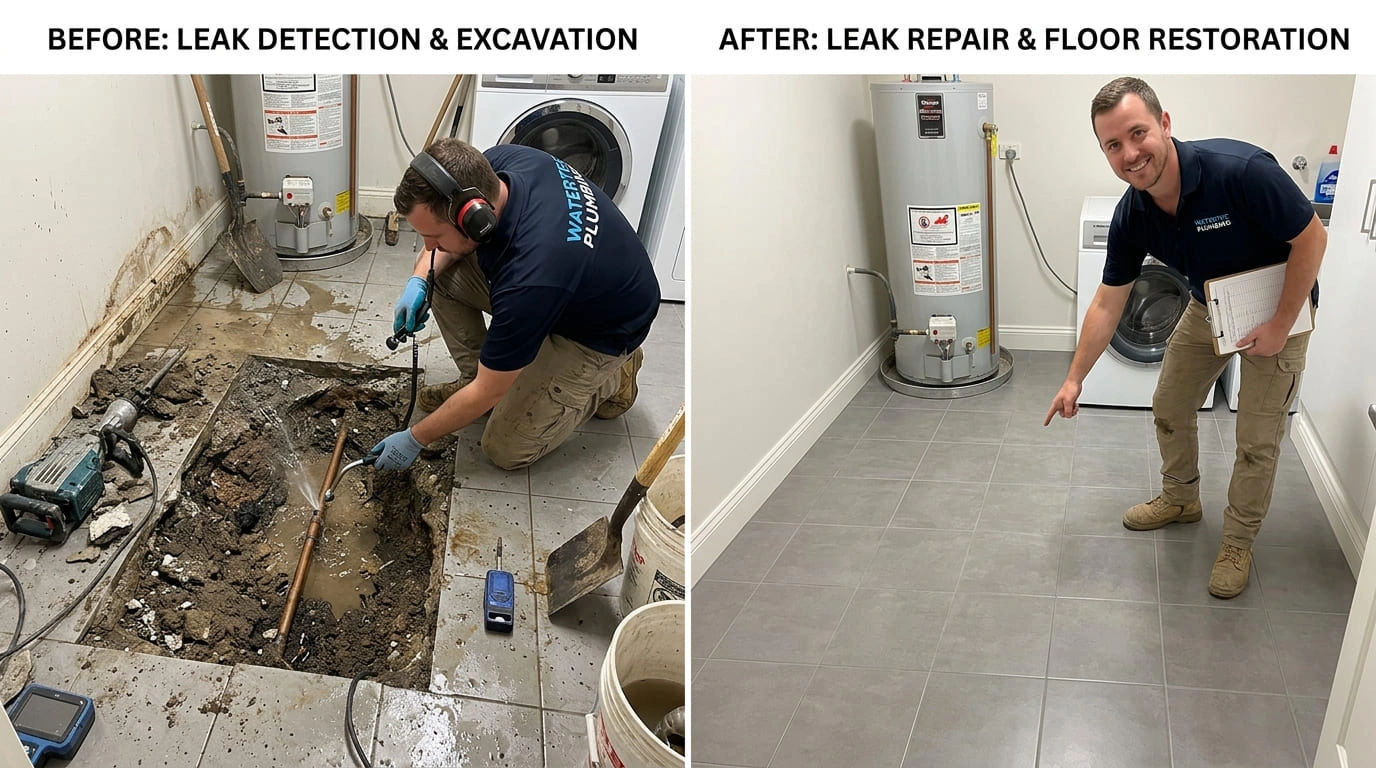
How Are Water Leaks Under Concrete Located?
Pressure tests, listening equipment, and thermal clues answer different questions.
Professional slab leak investigations can combine line tracing, pressure testing, and locating the area of water loss. The purpose is to build a defensible picture of the problem before selecting a repair approach.
Methods That May Be Appropriate Include:
A thermal image does not directly show every pipe through concrete, and a pressure drop does not by itself identify an exact repair point. Ask which methods are proposed and what each result means.
Should You Choose Spot Repair, Rerouting, or Repiping?
The right option depends on the affected line and the wider plumbing condition.
Locating the leak is a starting point for evaluating repair—not an automatic instruction to replace every water line.
| Situation | Spot Repair May Suit | Rerouting or Repiping May Suit |
|---|---|---|
| Accessible isolated defect | A limited repair area with otherwise serviceable piping | When access makes a direct repair impractical |
| Leak beneath fixed cabinetry | When access can be controlled economically | When a different route reduces major disruption |
| Repeated failures | Where separate causes can be addressed | Where broader pipe condition supports replacement |
| Wider plumbing concerns | A targeted repair may provide temporary resolution | A planned replacement may better address the overall problem |
Consider a Broader Replacement Discussion When:
- Several failures suggest a wider condition problem
- Repair access would repeatedly disrupt finished spaces
- Existing piping needs substantial correction
- A redesigned route offers a practical long-term solution
Ask how abandoned piping will be disconnected and how the proposed new route will be installed and protected.
How Much Does Slab Leak Detection Cost in Jacksonville?
Detection, repair, and restoration are separate budgeting questions.
There is no responsible single price for every concealed leak. The investigation may involve one accessible plumbing section or several difficult-to-isolate areas in a large building.
Main Cost Drivers Include:
| Service Component | What Affects the Estimate |
|---|---|
| Initial diagnostic visit | Agreed scope, access, and investigation time |
| Additional locating work | Complexity and specialist requirements |
| Pipe repair | Location, materials, and access |
| Rerouting or repiping | New route, pipe coverage, and installation scope |
| Restoration | Concrete, cabinetry, flooring, and drying requirements |
Ask whether diagnostic charges are credited toward later work; do not assume they are. A repair estimate may need to follow detection because the location determines access and labor.
Which Jacksonville Properties Should Investigate a Possible Slab Leak?
Look for unexplained patterns—not just visible flooding.
Consider arranging an assessment when:
- Water consumption rises without a clear usage change
- You hear running water while normal fixtures are off
- A floor develops an unexplained warm or damp area
- Moisture returns after the surface is dried
- Previous under-slab repairs are followed by new symptoms
- An exterior leak has not explained ongoing consumption
These are reasons to investigate, not proof of a slab leak. Increased usage can also involve fixtures, irrigation, appliances, or other plumbing.
There is no universal requirement that every slab-foundation property undergo annual certified leak testing.
Commercial Plumbing Leak Detection for Jacksonville Businesses
Plan the investigation around tenants, customers, and essential operations.
Commercial slab leak detection requires attention to more than the suspected pipe. Access permissions, operating hours, isolation points, and responsible decision-makers all affect how work proceeds.
Cummer Jack Plumbing supports discussions with building owners, facility managers, and property managers to organize the next step.
| Commercial Service Need | Planning Consideration |
|---|---|
| Diagnostic investigation | Identify the affected area and accessible systems |
| Repair planning | Establish approval and shutdown requirements |
| Rerouting or replacement | Evaluate new routes and occupied-space impacts |
| Documentation | Record findings and completed work |
| Follow-up coordination | Plan access for later repair or restoration |
Properties May Include:
- Retail centers and offices
- Restaurants and hospitality premises
- Apartment and mixed-use buildings
- Schools, churches, and community facilities
- Warehouses and other business properties
Commercial customers benefit from a defined scope, an identified point of contact, and a clear distinction between investigation and permanent repair.
| Site Condition | Budget & Scheduling Consideration |
|---|---|
| Multiple occupied units | Access coordination and phased work |
| Large buildings | Several plumbing zones or investigation areas |
| Restricted work areas | Safety procedures and authorized entry |
| Business-hour limitations | Scheduling around operations |
Why Arrange Professional Under-Slab Leak Investigation?
A structured assessment helps replace assumptions with evidence.
Professional investigation can help determine whether the concern involves concealed supply piping and where further work should focus. Line tracing, testing, and location work are established elements of slab leak investigation.
Practical Benefits Include:
- A clearer basis for repair planning
- Better understanding of access requirements
- Identification of questions that still need investigation
- More informed comparisons between repair options
- Useful records of the work performed
No diagnostic service can guarantee the future condition of all piping. The value lies in the findings and their appropriate interpretation.
Why DIY Concrete Cutting Is Not a Leak Detection Plan
Avoid turning an uncertain plumbing problem into a larger access problem.
You can record symptoms, compare bills, and describe when moisture appears. Cutting a slab or disturbing concealed services is a different matter.
Safety Warnings
- Do not drill or cut concrete based only on a warm or wet spot
- Do not attempt improvised pressure testing
- Do not force an unfamiliar or damaged shutoff valve
- Keep people away from wet areas involving electrical equipment
- Tell the technician about known embedded services and previous alterations
For rapid water loss, call promptly for guidance about safe next steps. Do not enter a hazardous wet electrical area to reach a valve.
Answers About Hidden Leaks, Detection Fees, and Repairs
Straightforward information before you book.
Concealed water loss is one possibility, but increased irrigation, leaking fixtures, and changed use can also affect consumption. The bill alone does not identify the source. Professional slab leak detection can investigate unexplained consumption in Jacksonville properties.
Yes. Visible water is not required for a concealed plumbing leak to warrant investigation. Increased consumption or running-water sounds may be the first noticeable clues. Contact Cummer Jack Plumbing for slab leak detection in Jacksonville, FL.
First account for automatic water users and fixtures that may still be operating. Unexplained meter activity warrants further investigation, but it does not locate the leak. Cummer Jack Plumbing provides water leak detection and slab leak investigation across Jacksonville and Duval County.
Many investigations begin with non-destructive methods. Whether an opening becomes necessary depends on the findings and the repair plan.
It can be. Ask what the quoted fee covers and whether specialist locating, pipe repair, and restoration are separate.
The access challenge becomes part of the repair decision. A direct repair, a new pipe route, or a broader replacement may need comparison.
Only if those items are expressly included. Request a scope that identifies who opens the area, who patches it, and who restores finishes. Concrete cutting, tile replacement, and restoration are typically separate from detection and pipe repair.
Not automatically. Consider the leak history, pipe condition, access costs, and proposed alternatives before deciding. Cummer Jack Plumbing offers pipe repiping services and can help you compare repair versus replacement options.
For qualifying water loss that did not enter the sewer, JEA's residential form requires a plumber's statement or receipt supporting a completed repair. A diagnosis alone does not establish that the repair was completed.
Cummer Jack Plumbing offers 24/7 contact for urgent plumbing needs. Call to discuss the problem and current dispatch availability.
Know the Scope, the Findings, and the Next Step
Written service terms matter more than broad promises.
Our approach is to make the proposed work understandable before you authorize it. Ask for the diagnostic scope, any additional-work conditions, and the terms that apply to later repairs.
A newly discovered leak elsewhere in a system is not necessarily a failure of an earlier repair. Any guarantee or warranty should identify the covered work and applicable conditions.
Schedule Slab Leak Service
Call Now: (904) 227-4220cummerjacksonplumbing@gmail.com
Cummer Jack Plumbing · 735 Lane Ave N · Jacksonville, FL 32254
Plumbing Qualifications for Detection and Repair Projects
Understand who performs each part of your project.
Leak location, plumbing repair, excavation, and specialist work can involve different responsibilities. Discuss the assigned personnel and the qualifications relevant to the actual scope.
Relevant Credential Categories May Include:
- Florida Certified Plumbing Contractor
- Registered Plumbing Contractor, where applicable
- Journeyman plumbing qualifications
- Underground utility and excavation credentials for applicable work
- Additional specialist qualifications when the project requires them
A list of credential categories is not a substitute for identifying the responsible contractor and the work covered by the agreement.
Emergency Slab Leak Assistance in Jacksonville
Respond to active water loss without confusing mitigation with permanent repair.
A rapidly developing wet area, substantial unexplained consumption, or loss of normal plumbing service deserves prompt attention. Call Cummer Jack Plumbing to explain what is happening and discuss immediate service options.
Emergency Response Planning Includes:
- Assessing the reported symptoms and urgency
- Discussing safe access and shutoff information
- Arranging an appropriate visit
- Evaluating temporary mitigation where feasible
- Planning investigation and permanent repair
Urgent Situations Include:
- Water spreading through an occupied room
- A suspected leak affecting multiple units
- Significant running-water sounds with no normal use
- A commercial plumbing problem interrupting essential operations
Slab Leak Documentation for Insurance and JEA Requests
Keep diagnosis, completed repairs, and coverage decisions separate.
Useful records may include the reported symptoms, observed conditions, photographs, findings, and invoices for completed work. Request the documents relevant to your project when arranging service.
Documentation to Retain:
- Inspection notes and dated photographs
- Description of the affected plumbing
- Diagnostic findings and limitations
- Authorized repair scope
- Completed-repair invoices
- Available restoration records
Insurance coverage depends on the policy and the insurer's decision. Documentation does not guarantee payment.
For JEA residential requests, the published form specifies a 90-day submission window tied to the billing period, limits adjustments to two in 36 months per residence, and requires completed-repair evidence for qualifying slab-leak wastewater adjustments. Approval is conditional. Commercial customers should use the applicable commercial process rather than assuming residential terms apply.
Written Terms for Diagnosis, Repairs, and Replacement Piping
Different parts of the project can have different protections.
Ask for the terms applying to the actual work before authorizing it. A diagnostic visit, a repaired pipe section, and a whole-house repipe are different services.
| Category | Terms to Understand |
|---|---|
| Diagnostic service | Scope, findings, limitations, and any follow-up provisions |
| Repair workmanship | Covered work, duration, and exclusions |
| Replacement materials | Applicable manufacturer terms |
| Restoration | Which contractor is responsible and what is included |
Keep invoices and written terms together. Do not assume a warranty on one repaired section covers unrelated piping or future leaks elsewhere.
Six Equipped Service Vans Supporting Jacksonville Plumbing Work
Match the assigned equipment to the investigation.
Cummer Jack Plumbing operates six service vans supporting our residential and commercial plumbing services. Before a suspected slab leak appointment, explain the symptoms and any previous tests so the required diagnostic scope can be discussed.
Equipment Planning May Involve:
- Pressure-testing equipment
- Specialist acoustic or locating tools
- Inspection and documentation equipment
- Repair tools and materials for separately authorized work
Specialist equipment needs depend on the project. A stocked van does not mean every hidden leak can be located and repaired in one visit.
Payment Planning for Rerouting and Repiping Projects
Separate the immediate investigation from the larger capital decision.
A diagnostic visit may lead to a limited repair or a more substantial proposal. Before committing, request an itemized scope and discuss payment arrangements directly with our office.
- Ask which payment methods are accepted
- Review any deposit and progress-payment requirements
- Discuss whether the proposed work can be sensibly phased
- Ask whether project-specific financing options are available
- Review any financing agreement separately from the plumbing contract
Financing availability, eligibility, interest, and repayment terms should be established before you rely on them in your budget.
Choose a Jacksonville Plumbing Team on Relevant Evidence
Practical capability should lead your decision.
Awards can be useful background, but a concealed leak requires a clear scope and an appropriate investigation. Choose a provider who can explain the next step in terms you understand.
Look For:
- Relevant plumbing experience
- Clear responsibility for specialist detection
- Written pricing and authorization procedures
- A practical access and repair plan
- Useful documentation
- Clear communication after the visit
For your property, the strongest evidence is how well the proposed service addresses the actual problem.
Plumbing Offers and Discount Eligibility
Understand the terms before adding an offer to your budget.
Contact Cummer Jack Plumbing about current promotions and whether any apply to your proposed work. Our listed offers include savings on qualifying plumbing repairs and selected other services.
- Ask whether senior or military discounts are currently available
- Check whether an offer applies to diagnosis, repair, or replacement
- Ask whether promotions can be combined
- Review exclusions and minimum-service conditions
- Confirm the final authorized price before work begins
A drain-clearing or water-heater promotion should not be assumed to apply to slab leak detection.
Slab Leak Service Hours in Jacksonville, FL
Call day or night to discuss an urgent plumbing concern.
Cummer Jack Plumbing offers 24/7 availability for plumbing inquiries and emergency service requests. Appointment timing, specialist investigation, and repair scheduling depend on the work required and current availability.
| Day | Contact Hours |
|---|---|
| Monday | Open 24 Hours |
| Tuesday | Open 24 Hours |
| Wednesday | Open 24 Hours |
| Thursday | Open 24 Hours |
| Friday | Open 24 Hours |
| Saturday | Open 24 Hours |
| Sunday | Open 24 Hours |
Phone: (904) 227-4220
Email: cummerjacksonplumbing@gmail.com
Website: emergencyplumberjacksonvillefl.com
How to Compare Slab Leak Detection Providers in Jacksonville
Ask every provider the same questions.
A lower initial fee may cover a different service. Compare the investigation, deliverables, additional-work conditions, and repair responsibilities before choosing.
| Feature | Discuss With Cummer Jack Plumbing | Ask Any Other Provider |
|---|---|---|
| Diagnostic scope | Which plumbing and symptoms will be investigated? | What is included in the quoted visit? |
| Specialist involvement | Who performs any specialist locating? | Is specialist work subcontracted or separately charged? |
| Findings | What records or location information will be provided? | How are limitations explained? |
| Repair planning | Can repair options be discussed after findings? | Who quotes and performs the repair? |
| Restoration | Which items are excluded or separately arranged? | Who handles concrete and finishes? |
| Availability | What can be scheduled now? | Does 24/7 mean calls, dispatch, or all services? |
A fair comparison avoids assumptions about another company's experience, staffing, or service quality.
Contact Cummer Jack Plumbing for Slab Leak Detection in Jacksonville
Tell us what changed, what you can hear, and where moisture appears.
You do not need to know the leak location before calling. Explain the symptoms, provide the property address, and tell us about any previous plumbing work. We will discuss the appropriate next step and the information needed to plan the visit.
For commercial properties, include access restrictions, operating hours, affected units, and the person authorized to approve work.
Contact Cummer Jack Plumbing
(904) 227-4220
cummerjacksonplumbing@gmail.com
735 Lane Ave N
Jacksonville, FL 32254, United States
24/7 Emergency Service Available
Current Special Offers
- $29 Water Heater Flush & Maintenance
- $50 Off Any Plumbing Repair
- $99 Drain Clearing Special
- Free In-Home Water Quality Test
- Up to $500 Off Water Heater Replacement
Take the next step toward understanding concealed water loss with slab leak detection in Jacksonville, FL, from Cummer Jack Plumbing.
Slab Leak Detection Across Jacksonville & Northeast Florida
Our team of 60 professionals responds across Northeast Florida with 6 fully equipped service vans for slab leak detection, water leak detection, pipe repiping, and all plumbing services.