Jacksonville Sump Pump Repair & Replacement — Available 24/7
Northeast Florida sump pump service for homes, businesses, crawlspaces, and drainage systems.
Need sump pump repair & replacement in Jacksonville, FL? Cummer Jack Plumbing helps identify why your pump will not start, runs without removing water, cycles repeatedly, or cannot keep up with incoming water. We look beyond the motor to assess the float switch, basin, check valve, discharge connections, and overall pumping arrangement.
Serving Jacksonville since 2010, our company brings a team of 60 skilled professionals and six equipped service vans to residential and commercial plumbing needs. Whether you need an urgent diagnosis or a planned replacement, start with a clear explanation of the problem—not an automatic recommendation to buy a larger pump.
- Diagnosis for pumps that will not start, stop, or drain properly.
- Repair and replacement options explained before approved work begins.
- Crawlspace, outdoor drainage, and commercial applications.
- Around-the-clock emergency plumbing availability.
Request Sump Pump Service
Fill out the form and we'll contact you immediately!
Sump Pump Service Backed by 16 Years Serving Jacksonville
Local plumbing experience, practical recommendations, and clear communication.
A dependable pumping system starts with an accurate diagnosis. Replacing the pump alone may not resolve a blocked outlet, returning discharge water, an obstructed float, or a basin arrangement that causes repeated cycling.
Cummer Jack Plumbing combines residential service with broader commercial plumbing support, giving property owners one point of contact for pump concerns and related plumbing problems. Our published company information identifies licensed plumbing personnel, insured operations, written estimates, and 24/7 emergency service.
- Serving Jacksonville since 2010.
- Residential and commercial plumbing capabilities.
- Six equipped service vans supporting local service calls.
- Written estimates before approved repairs.
- Emergency assistance available seven days a week.
Sump Pump Repair Near Jacksonville Neighborhoods and Business Hubs
Helping property owners from Riverside and Murray Hill to Mandarin and Arlington.
Your drainage problem is specific to your property—not simply your ZIP code. A crawlspace basin, an outdoor collection pit, and a commercial low-point drainage system can require different equipment and discharge arrangements.
Cummer Jack Plumbing serves Jacksonville properties across residential neighborhoods and business districts. When you call, provide your address, pump location, access conditions, and whether water is actively rising so we can understand the situation before scheduling. Our published service coverage includes Jacksonville and surrounding communities.
- Jacksonville neighborhoods: Riverside, Murray Hill, Mandarin, Arlington, Baymeadows, Oceanway, and surrounding areas.
- Nearby communities: Orange Park, Atlantic Beach, Neptune Beach, Jacksonville Beach, and Ponte Vedra Beach.
- Local context: properties around Downtown, the riverfront, and major commercial corridors require individual drainage assessments—not assumptions based on nearby landmarks.
Specialized Sump Pump Diagnosis for Residential and Commercial Systems
Find the failed component—and the conditions contributing to the failure.
A pump can make noise without moving water. It can also operate correctly while incoming water exceeds what the system can remove. Effective troubleshooting separates these situations before parts are replaced.
Manufacturer guidance identifies restricted discharge lines, check-valve problems, float interference, air locking, and operating conditions beyond pump capacity among relevant troubleshooting considerations. The correct checks depend on the installed model and configuration.
Our service approach considers:
- Pump operation and visible equipment condition.
- Float movement and available basin clearance.
- Check-valve function and accessible discharge connections.
- Pump suitability for the required lift and piping arrangement.
- Related access, drainage, or electrical concerns requiring separate attention.
What Happens When Your Sump Pump Fails in Jacksonville?
A silent pump, constant running, and rapid cycling mean different things.
When the pump stops removing collected water, the basin can fill and overflow. But the reason may be a failed component, restricted discharge, unsuitable capacity, or continued inflow—not necessarily a burned-out motor.
Watch for these symptoms:
Pump will not start
The float, power supply, controls, or pump may need investigation.
Pump hums but does not drain
Obstruction, air locking, discharge restrictions, or internal problems may be involved.
Pump never stops
The float may be stuck, water may keep entering, or the system may not be removing water effectively.
Pump starts every few seconds
Returning water, control settings, or basin configuration may contribute.
Water returns after shutdown
The check valve and discharge arrangement deserve attention.
Manufacturer troubleshooting documents support evaluating these conditions as a system rather than treating every symptom as proof that replacement is necessary. If you notice any of these symptoms, contact our team for a professional assessment.
Prevent Avoidable Pump Problems with Scheduled Service
Maintenance should follow your equipment's instructions and actual operating conditions.
A scheduled service visit can help identify debris, float interference, damaged connections, and changes in operation before the next period of heavy use. Maintenance frequency varies by model, application, and duty; an annual appointment does not replace more frequent checks required by the manufacturer.
Some equipment manuals specify monthly operational checks. There is no single maintenance interval appropriate for every pumping system.
| Task | Description | Typical Timing | Reliability Impact |
|---|---|---|---|
| Visual inspection | Check accessible components, connections, and basin condition | Scheduled service | Identifies visible deterioration |
| Operational check | Observe start, pumping, and shutoff behavior | Per manufacturer instructions | Identifies control and performance concerns |
| Debris assessment | Inspect for material interfering with intake or float movement | Based on conditions | Helps prevent obstruction |
| Discharge review | Check accessible piping, check valve, and outlet conditions | Scheduled service | Identifies restrictions or returning water |
| Service documentation | Record findings and recommendations | Each professional visit | Supports maintenance planning |
Seasonal planning:
- Arrange service before anticipated periods of heavy operation.
- Recheck the system after nearby construction or drainage changes.
- Investigate unusual sounds or cycling rather than waiting for the next scheduled visit.
Frequency and certification: ordinary maintenance records are not the same as a universal municipal sump-pump certification. Any project-specific permit or inspection requirements should be addressed separately.
Cost considerations: access, equipment type, system condition, and required corrective work determine the scope.
Owner maintenance reminders:
- Keep access clear.
- Retain equipment manuals and service records.
- Report changes in sound, cycle length, or water level.
Who Needs Sump Pump Repair in Jacksonville?
Support for homeowners, property managers, and commercial facilities.
If your property depends on a pump to remove collected groundwater or drainage water, a change in performance deserves attention. The right service depends on what the system handles and how the property uses it.
We help with inquiries involving:
- Homes with crawlspace or other collection-basin systems.
- Rental properties and multifamily buildings.
- HOAs responsible for shared drainage equipment.
- Offices, retail properties, and hospitality facilities.
- Warehouses and commercial buildings with designated drainage systems.
- Properties with existing outdoor collection pits.
Describe what enters the basin when calling. Groundwater pumps, sewage ejectors, septic pumps, and industrial process pumps are not interchangeable service applications.
How Northeast Florida Rain and Drainage Conditions Affect Your Pump
Heavy rainfall is only one part of the water-management picture.
Duval County experiences coastal, inland, and river flooding. Jacksonville identifies June through November as its most common flooding period and notes that creeks and tributaries of the St. Johns River can contribute to rising water.
That makes property-level diagnosis essential. A working sump pump is not a guarantee against river flooding, storm surge, or water entering faster than the complete system can remove it. If water damage has already occurred, our water damage restoration services can help.
Seasonal considerations:
- Rainy periods: increased inflow can expose capacity or discharge limitations.
- Storm preparation: check normal operation and assess backup needs before severe weather.
- Drier periods: investigate unexpected pumping rather than assuming rainfall is responsible.
- After landscaping or construction: reassess changes that may redirect water toward the basin.
Common Sump Pump Types and Backup Arrangements
Equipment selection depends on the application—not horsepower alone.
Pump configuration, basin dimensions, incoming water, discharge lift, and piping resistance all influence selection. A replacement must suit the complete arrangement.
| Type or Arrangement | Typical Application | Main Consideration | Potential Benefit |
|---|---|---|---|
| Submersible primary pump | Pump installed within a collection basin | Compatibility with basin and duty | Compact pumping arrangement |
| Pedestal primary pump | Motor positioned above the basin | Clearance and installation suitability | Accessible motor arrangement |
| Battery backup pump | Supplemental pumping during primary-power interruption | Battery, charger, controls, and discharge compatibility | Additional pumping capability |
| Duplex arrangement | Two pumps coordinated through suitable controls | Alternation, capacity, alarm, and maintenance design | Redundancy or staged operation |
| Outdoor drainage application | Suitable equipment in an exterior collection system | Environmental exposure and water characteristics | Removal from low points without gravity drainage |
These categories overlap: "outdoor" describes the application, while "submersible" describes a pump configuration.
Reliability depends on suitable selection, installation, maintenance, and operating conditions. Backup equipment also requires its own checks; a low battery or blocked discharge can compromise operation.
Our 6-Step Sump Pump Service Process
Know what to expect when Cummer Jack Plumbing arrives.
Initial Call & Property Assessment
Tell us the symptoms, pump location, property type, and whether water is actively rising.
On-Site Inspection & Access Review
We assess accessible equipment, basin conditions, connections, and safe access before proceeding.
Diagnostic Checks
We investigate activation, pumping, shutoff, and relevant discharge conditions using methods appropriate to the equipment.
Repair or Replacement Recommendations
You receive an explanation of the findings and a written estimate for the proposed work.
Approved Work & Operational Checks
After authorization, we complete the agreed scope and check the resulting operation under available site conditions.
Documentation & Next Steps
We explain the work, maintenance considerations, and any remaining drainage or electrical issues requiring attention.
Cummer Jack Plumbing's published service process includes assessment, written estimates before work, approved repairs, and cleanup.
What's Included in Sump Pump Repair & Replacement?
Your estimate should identify the work—not leave you guessing.
A diagnostic visit, component repair, and full replacement are different scopes. We explain what is proposed and identify additional work before treating it as part of the job.
Depending on the approved scope, service may include:
- Assessment of the reported symptoms.
- Inspection of accessible pump and basin components.
- Float-switch and operational checks.
- Review of accessible check-valve and discharge connections.
- Approved component repair or pump replacement.
- Operational checks following the work.
- Findings, invoice details, and maintenance recommendations.
New excavation, basin replacement, discharge rerouting, electrical modifications, backup equipment, and restoration should be separately identified when needed. A replacement quote should also state whether removal and disposal of the old pump are included. For related pipe repair or water line work, additional scoping is required.
What Makes Our Jacksonville Pump Service Useful?
Straightforward diagnosis, written estimates, and broader plumbing support.
You should understand what failed, what the proposed work addresses, and what it cannot guarantee. Our goal is to make those distinctions clear before you decide.
- Residential and commercial plumbing support through one company.
- Written estimates before approved work.
- Repair and replacement recommendations based on site findings.
- Emergency contact availability around the clock.
- Access to related plumbing services when the source of water is uncertain—including water leak detection, drain cleaning, and sewer line repair.
Cummer Jack Plumbing publishes these broader service capabilities and operating commitments on its company website.
What Changes After a Pump Problem Is Properly Diagnosed?
The meaningful transformation is documented operation—not a cosmetic change.
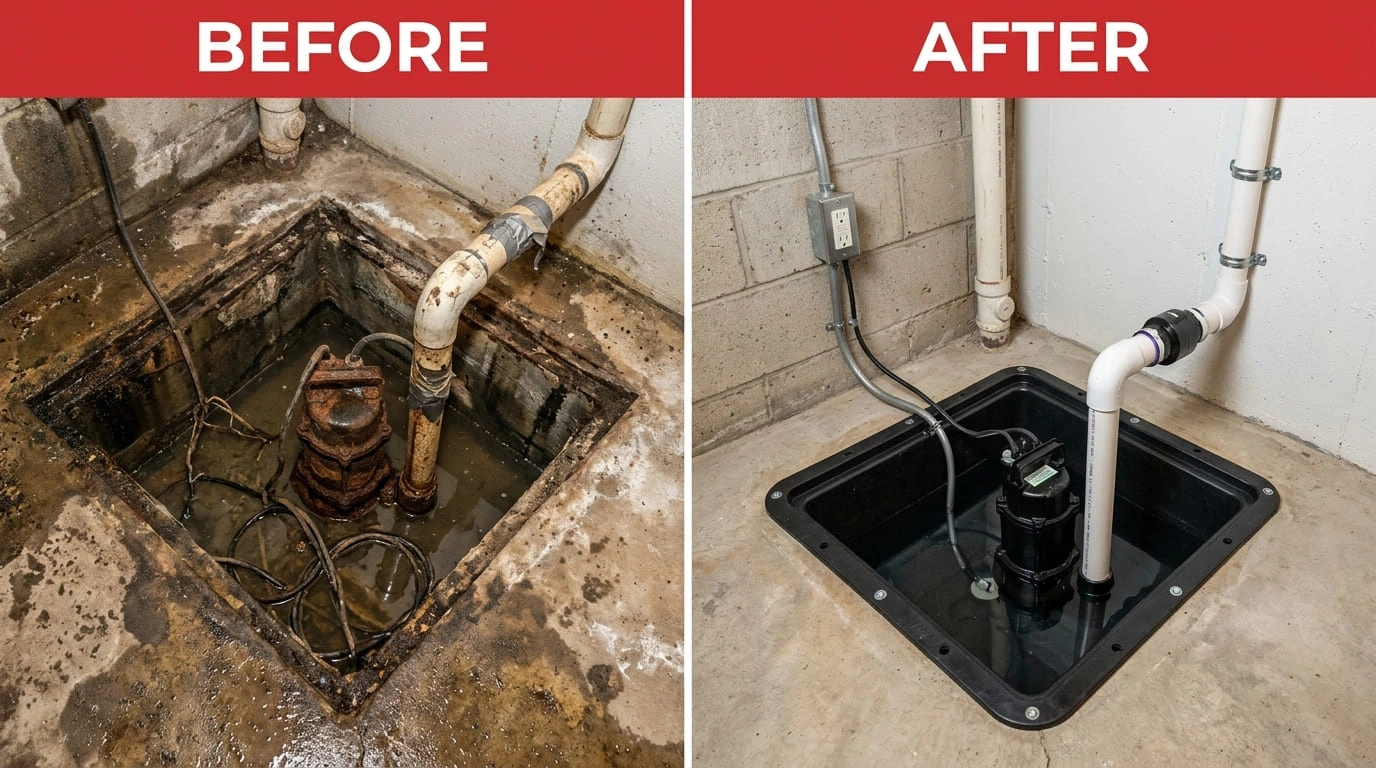
A useful before-and-after comparison explains the symptom, the cause identified, and the work completed. It should also distinguish restored pump operation from a guarantee against every future flooding event.
Examples of service outcomes:
A pump hums while water remains high.
The diagnosed cause is addressed and pumping operation is checked.
Water returns immediately after shutdown.
The approved check-valve or discharge correction is completed and reviewed.
The owner does not know what is installed.
Equipment details and service recommendations are documented.
Repeated cycling has no clear explanation.
Controls, basin conditions, and returning water have been assessed.
How We Repair and Replace Sump Pump Systems
Compatibility matters more than choosing the largest available pump.
A replacement should match the system's operating requirements and fit the existing installation—or include the changes needed to make the arrangement suitable.
Our proposed work considers:
- Pump performance at the required discharge lift.
- Suitable materials and connections.
- Float clearance and control arrangement.
- Accessible check-valve placement.
- Manufacturer-specified installation details.
- Environmental protection appropriate to the location.
- Safe service access and applicable project requirements.
Manufacturer instructions are model-specific. For example, some installations require particular venting provisions to prevent air locking; copying a detail from another pump without checking compatibility is not an appropriate installation method.
Should You Repair Your Sump Pump or Replace It?
A failed switch does not automatically mean a failed pump.
Repair can make sense when an identifiable component problem can be corrected and the remaining equipment is suitable. Replacement becomes more compelling when the pump is damaged, unreliable, unsupported, or inappropriate for the application.
| Scenario | Repair May Be Appropriate | Replacement May Be Appropriate |
|---|---|---|
| Accessible float interference | Obstruction or positioning can be corrected | Pump or controls have additional damage |
| Serviceable switch failure | Compatible replacement is available | Integrated design or condition makes repair impractical |
| Check-valve or connection problem | Pump remains serviceable | Pump has separate significant defects |
| Repeated operating failures | A correctable external cause is found | Pump condition makes dependable repair unlikely |
| Insufficient performance | Discharge restrictions can be corrected | Properly evaluated demand requires different equipment |
| Damaged housing or internal components | Manufacturer-supported repair is practical | Damage makes replacement the sensible option |
Replacement deserves consideration when:
- The pump has significant physical damage.
- Repair costs are disproportionate to the remaining value.
- Compatible parts are unavailable.
- Performance remains unsuitable after system issues are evaluated.
A larger pump will not automatically fix a blocked discharge route.
How Much Does Sump Pump Repair or Replacement Cost in Jacksonville?
The most useful estimate explains what is included.
There is no reliable single price for every property. Replacing an accessible pump in a suitable basin is a different project from installing a new basin, revising discharge piping, or correcting unsafe access.
Main cost drivers:
- Pump type and required performance.
- Access to the basin.
- Condition of valves, piping, and connections.
- Component repair versus complete replacement.
- Backup equipment and controls.
- Excavation or drainage changes.
- Emergency scheduling and separate specialist work.
| Service Type | Estimate Basis |
|---|---|
| Diagnostic visit | Access and assessment scope |
| Float-switch or component repair | Compatibility, parts, and labor |
| Primary pump replacement | Equipment and installation requirements |
| Check-valve or discharge work | Accessible repair versus wider rerouting |
| Backup addition | Pump, battery, controls, space, and connections |
| Commercial system work | Capacity, controls, access, and operational coordination |
Cummer Jack Plumbing's website states that customers receive written estimates before work begins. Ask for the pump model, included components, additional-work conditions, and applicable warranty terms in your proposal.
Request a Sump Pump Cost EstimateWhich Jacksonville Properties Need Pump Repair or Replacement?
Focus on symptoms and system dependence—not a generic property list.
A property may need service because an existing pump is malfunctioning, because conditions have changed, or because planned replacement is more practical than waiting for failure.
Arrange an assessment when:
- Water rises but the pump does not activate.
- The motor runs without lowering the water level.
- The pump cycles repeatedly without an obvious explanation.
- New noise, leakage, or vibration appears.
- Water returns through the discharge arrangement.
- The property has experienced repeated pumping failures.
- Equipment changes or drainage work may have altered system requirements.
Having a pool, restaurant, or medical office does not by itself establish that the property requires this particular type of pump. Applicability depends on the actual installation and water-management need.
Commercial Sump Pump Repair & Replacement in Jacksonville
Coordinate work around access, operations, and property-management needs.
Commercial pump problems can affect storage areas, service spaces, tenants, and business continuity. Cummer Jack Plumbing provides broader commercial plumbing services alongside its residential work, supporting inquiries from offices, retail properties, hospitality facilities, and multi-unit buildings.
| Commercial Service | Scope Consideration |
|---|---|
| Diagnostic assessment | Identify the reported fault and relevant system conditions |
| Component repairs | Address approved serviceable parts |
| Pump replacement | Select and install suitable replacement equipment |
| System documentation | Record equipment and completed work |
| Maintenance planning | Coordinate appropriate checks and future access |
Properties we can discuss:
- Shopping centers and office buildings.
- Restaurants and hospitality properties.
- Multifamily buildings and managed communities.
- Warehouses and commercial facilities.
- Schools, churches, and community buildings with applicable systems.
Why a coordinated approach matters:
- Clear communication with the authorized manager.
- Defined access and shutdown arrangements.
- Written approval of additional work.
- Documentation for property maintenance records.
| Project Type | Planning Considerations |
|---|---|
| Multiple basins | Equipment inventory and staged access |
| Occupied buildings | Tenant communication and work-area control |
| Critical drainage areas | Temporary measures and continuity planning |
| Controlled-access facilities | Site rules and authorized entry |
Why Hire a Professional for Sump Pump Service?
Understand the cause, the options, and the limitations.
Professional service should provide more than a new component. It should explain why the system behaved differently and whether related conditions remain unresolved.
Benefits include:
- Separating pump failure from discharge or inflow problems.
- Selecting compatible equipment.
- Identifying access and safety concerns.
- Understanding what the estimate includes.
- Receiving records of completed work.
- Getting a practical maintenance plan.
Manufacturer troubleshooting guidance identifies several possible causes for similar symptoms, reinforcing the value of diagnosis before replacement. Related services such as sewer camera inspection and water leak detection can help identify where water is entering the system.
Is It Safe to Check a Sump Pump in Standing Water?
Stay out of flooded areas where electrical equipment may be involved.
Safety: do not touch electrical equipment if it is wet or if you are standing in water. Ready.gov advises switching off electricity only when it is safe to do so and warns against wading through floodwater.
- Do not enter a flooded crawlspace to reach a pump.
- Do not handle submerged plugs, receptacles, or extension cords.
- Do not repeatedly reset a tripping breaker to keep the pump running.
- Keep people and pets away from the affected area.
- Call emergency services if there is an immediate threat to life.
Turning off the building's water supply will not stop groundwater or stormwater entering the property. For active water damage situations, call our team immediately.
Call for Professional Pump AssistanceSump Pump Repair & Replacement FAQs in Jacksonville
Understand the symptoms before deciding on the next step.
Possible causes include restricted discharge, air locking, intake or impeller obstruction, or conditions beyond the pump's capability. The installed model and arrangement determine the appropriate diagnostic checks. Call (904) 227-4220 for a professional assessment.
Returning discharge water, a check-valve problem, control settings, basin size, or continued inflow may contribute. Frequent operation alone does not prove the motor is failing.
A hum does not establish a single cause. Mechanical restriction, electrical conditions, or internal failure may be involved. Avoid repeatedly attempting to operate malfunctioning equipment.
Sometimes. It depends on the switch design, pump condition, compatible parts, and manufacturer-supported service options.
A check valve that does not close properly may allow discharge water to return. The piping arrangement and water entering through other routes also need consideration.
The pump may not be collecting water from the affected location, inflow may exceed system performance, or the discharge arrangement may be ineffective. A functioning pump is only one part of drainage management. Our water leak detection services can help identify additional water sources.
Not by itself. The restriction must be identified and addressed as part of the approved work. Our drain cleaning and hydro jetting services may be needed for blocked discharge lines.
Potentially. Basin space, compatible controls, battery placement, discharge connections, and service access must be assessed.
Runtime depends on battery condition, pump demand, cycling frequency, and the equipment used. A single runtime promise is not appropriate for every installation.
Rising water, active overflow, or malfunctioning electrical equipment should not be treated as a routine appointment. Stay clear of unsafe areas and call to discuss urgency.
That depends on the cause. Pump components and private drainage work differ from public roadway or stormwater infrastructure issues. Our team can help determine the appropriate course of action.
Cummer Jack Plumbing provides 24/7 emergency plumbing service. Call (904) 227-4220 with your location and current conditions to discuss availability.
Clear Service Expectations from Diagnosis to Follow-Up
Written scope, explained findings, and a direct contact for concerns.
You deserve to know what was repaired, what was replaced, and what remains outside the completed scope. Keep your estimate, invoice, equipment information, and applicable warranty terms together.
If the same symptom returns, contact us with the job details. Further assessment can distinguish an issue with completed work from new debris, changing inflow, a blocked outlet, or another equipment problem.
Plumbing Credentials Supporting Jacksonville Pump Service
Match the qualifications to the actual project scope.
Cummer Jack Plumbing's website lists Florida plumbing contractor and journeyman qualifications, along with additional specialty certifications. Those specialty credentials relate to their respective work categories; they should not be confused with a universal sump-pump certification.
Published credential categories include:
- Florida Certified Plumbing Contractor.
- Florida journeyman plumbing qualifications.
- ASSE backflow-prevention certification.
- Medical gas certification.
- EPA lead-safe renovation certification.
Where a project involves separate electrical, excavation, or other specialist work, the estimate should identify the relevant responsibilities and arrangements. Learn more about our qualifications.
Emergency Sump Pump Service in Jacksonville
Call when the water level is rising—not after the basin overflows.
A pump that has stopped working during active inflow deserves prompt attention. Call Cummer Jack Plumbing at (904) 227-4220 and describe what you can observe from a safe location.
Our emergency intake focuses on:
- Your address and contact information.
- Whether water is actively rising or spreading.
- Whether the pump is silent, humming, cycling, or running continuously.
- Whether electrical equipment may be affected.
- Safe access and the next available response.
Common urgent scenarios:
- A basin approaching overflow.
- Pump operation without visible drainage.
- A disconnected or leaking discharge connection.
- Failure of the primary system during heavy inflow.
- A backup alarm accompanied by a high water level.
Cummer Jack Plumbing publishes 24/7 emergency availability; arrival depends on dispatch conditions and safe access.
Call (904) 227-4220 — Emergency ServiceDocumentation Support for Sump Pump-Related Damage
Service records can help explain what was observed and repaired.
If you report a loss to your insurer, maintenance and repair documents may help describe the equipment condition and completed work. Documentation does not establish that a claim is covered.
Useful records may include:
- Photos taken when safe.
- Inspection findings.
- Equipment details.
- The approved estimate.
- Repair or replacement invoices.
- A factual description of observed conditions.
Coverage depends on the policy, endorsements, exclusions, deductible, and cause of loss. Ask your insurer what records it requires; plumbing service is separate from insurance coverage advice or claim representation. For water-damage situations, our water damage restoration team can also provide documentation.
What Warranty Terms Apply to Sump Pump Repairs?
Manufacturer coverage and installation coverage are different.
Before approving a replacement, ask for the applicable written terms. Coverage can differ between a new pump, a replacement component, and the labor used to install it.
| Coverage Category | What to Review |
|---|---|
| Manufacturer equipment warranty | Covered defects, duration, exclusions, and claim procedure |
| Replacement parts | Whether separate component terms apply |
| Workmanship coverage | The written obligations covering completed installation or repair |
| Service records | Documents needed to identify the equipment and job |
| Additional costs | Whether removal, shipping, access, or labor is excluded |
A pump warranty is not the same as a guarantee against flooding or resulting property damage. Retain the specific terms supplied with your project rather than relying on a general description.
Six Equipped Service Vans Supporting Jacksonville Plumbing Work
Tools, people, and dispatch coordination for residential and commercial needs.
Cummer Jack Plumbing's published company information identifies 60 skilled professionals and six equipped vans serving Jacksonville and surrounding communities.
For a pump-service inquiry, preparation begins before arrival. Tell us the model if known, the basin location, access restrictions, and the symptoms.
Service preparation can involve:
- Suitable diagnostic equipment.
- Common plumbing connections and repair materials.
- Identification of model-specific parts.
- Planning for replacement equipment when required.
- Coordination of access and additional specialist work.
Equipment availability varies by model and application. A stocked van should not be confused with a guarantee that every pump or control component is immediately available.
Payment Options for Major Pump and Drainage Work
Understand the full proposal before choosing how to pay.
A straightforward replacement and a larger drainage project can have very different budgets. Ask for an itemized scope so essential repairs, optional backup equipment, and wider improvements are clearly separated.
Cummer Jack Plumbing's website lists cash, credit cards, and checks and invites customers to discuss payment options for larger projects. It does not establish a specific lending program or guaranteed financing approval.
Discuss:
- Accepted payment methods.
- Payment timing.
- Whether work can be appropriately phased.
- Separate pricing for optional equipment.
- Any available project-specific arrangements.
Recognition Highlighted by Cummer Jack Plumbing
Evaluate recognition alongside the scope and quality of your proposal.
Cummer Jack Plumbing's website highlights recognition under the following names and categories.
For your pump project, the practical decision still rests on a clear diagnosis, appropriate equipment, written pricing, and understandable service terms.
Senior and Military Plumbing Discounts in Jacksonville
Discuss eligibility before approving the work.
Cummer Jack Plumbing advertises senior and military discounts and other company promotions. Ask which offers apply to the proposed pump service and whether they can be combined.
- Senior-customer discount inquiries.
- Military and veteran discount inquiries.
- Current eligible service promotions.
- First-time customer offers where applicable.
The written estimate should show any approved discount. Offers for drain cleaning, water heaters, or sewer lining should not be assumed to apply to sump-pump work.
Sump Pump Service Hours in Jacksonville, FL
Emergency plumbing contact is available seven days a week.
Cummer Jack Plumbing publishes around-the-clock emergency availability. Call for current scheduling, dispatch information, and assistance describing the situation safely.
| Day | Published Availability |
|---|---|
| Monday | 00:00–23:59 |
| Tuesday | 00:00–23:59 |
| Wednesday | 00:00–23:59 |
| Thursday | 00:00–23:59 |
| Friday | 00:00–23:59 |
| Saturday | 00:00–23:59 |
| Sunday | 00:00–23:59 |
Phone: (904) 227-4220
Email: cummerjacksonplumbing@gmail.com
Website: emergencyplumberjacksonvillefl.com
How Should You Compare Jacksonville Sump Pump Providers?
Use the same questions when evaluating every estimate.
A useful comparison examines diagnosis, scope, equipment, service terms, and what happens if additional work is needed. Avoid deciding on price without checking whether proposals include the same work.
| Comparison Point | Cummer Jack Plumbing's Published Approach | What to Ask Any Provider |
|---|---|---|
| Availability | 24/7 emergency plumbing contact | When can you attend this address? |
| Pricing | Written estimate before work | What is included and excluded? |
| Service range | Residential and commercial plumbing | Can you address related plumbing concerns? |
| Company resources | 60 professionals and six equipped vans | Who will perform the work? |
| Diagnosis | Assessment before approved work | Will you inspect controls and discharge conditions? |
| Replacement terms | Project-specific proposal needed | Which model, components, and warranties are included? |
Company information above reflects Cummer Jack Plumbing's published service descriptions—not assumptions about competitors.
Contact Cummer Jack Plumbing for Sump Pump Service in Jacksonville
Tell us what the pump is doing—and whether water is rising.
Get Sump Pump Help Now
Whether you need an urgent assessment, a component repair, or a planned replacement, start with the symptoms. We can discuss your property, access conditions, and the next step toward a written service proposal.
(904) 227-4220
cummerjacksonplumbing@gmail.com
Sump Pump Repair & Replacement
735 Lane Ave N
Jacksonville, FL 32254, United States
24/7 Emergency Service Available
Current Special Offers
- $29 Water Heater Flush & Maintenance
- $50 Off Any Plumbing Repair
- $99 Drain Clearing Special
- Free In-Home Water Quality Test
- Up to $500 Off Water Heater Replacement
Get clear answers and practical options for sump pump repair & replacement in Jacksonville, FL, from Cummer Jack Plumbing.
Sump Pump Service Areas Near Jacksonville FL
Our team of 60 professionals responds across Northeast Florida with 6 fully equipped service vans. We serve Jacksonville Beach, Orange Park, St. Augustine, and all surrounding areas.